

Scientists Discovered This Unusual Dinosaur Fossil Off The Coast Of Canada
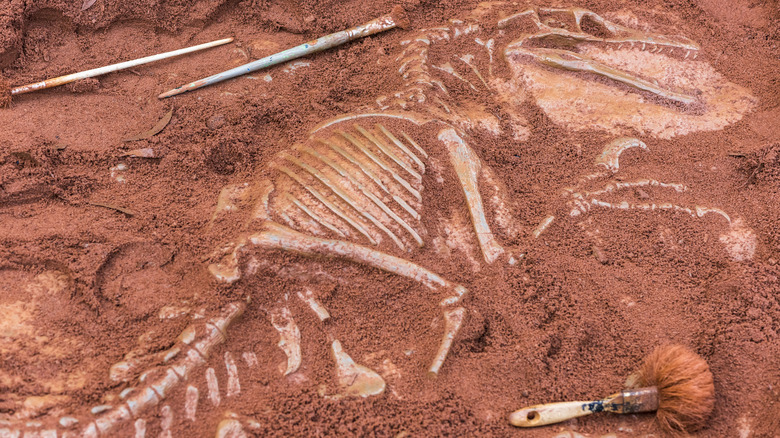
For millions of years, dinosaurs wandered the Earth, leaving fossilized remains on every continent. But these fossils are far from evenly distributed. Some regions have large amounts of fossils ready for the finding. But in some places, not a single dinosaur bone has been found despite years of searching. One such region is a formation of rock from the Cretaceous Period, one of the time periods in which dinosaurs lived, off the coast of British Columbia on Canada's west coast. However, scientists recently identified a fossil from this area as being from the tail of a bird-like dinosaur.
Paleontologists collected a fossil specimen on Denman Island off the coast of British Columbia. The shape of the specimen is consistent with bones from small tyrannosaurs and a group of ostrich-like dinosaurs known as ornithomimosaurs, both of which lived in what is now the western interior of North America. However, visual inspection of the roughly 2-inch-long fossil proved inconclusive. In a 2026 study, scientists used CT scans of the fossil to create a 3D model that they could closely compare to the tail bones of different dinosaurs. Using this method they determined that it was a tail bone from a species of ornithomimosaur.
Fast-running, ostrich-like dinosaurs
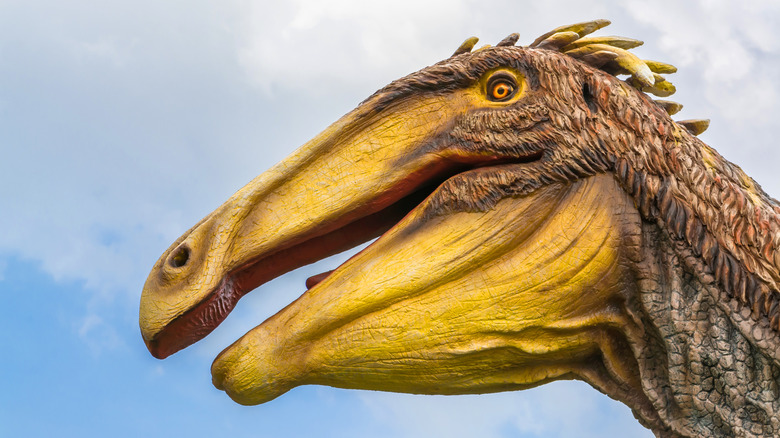
Ornithomimosaurs were a group of fast-running, bird-like dinosaurs that lived during the Cretaceous Period from 145 million to 66 million years ago. These dinosaurs resembled modern ostriches, with small heads, long necks, toothless beaks, and long legs that would have allowed them to run quickly. Some ornithomimosaur species could reach lengths of up to 13 feet and could run 35 miles per hour or more. Although scientists have determined that this particular fossil is from an ornithomimosaur, they aren't able to narrow down which species from this group it belonged to.
The fossil was found in a rock formation estimated to be 75 to 80 million years old. The Nanaimo Group covers eastern Vancouver Island, Canada's Gulf Islands, and the San Juan Islands of the United States. This formation is full of marine and coastal fossils, providing a record that spans around 20 million years of the Cretaceous Period; however, this is the first dinosaur fossil found in this formation. Researchers used fossils of ammonites found in the same layer as the dinosaur fossil to narrow down its age to the middle to late Campanian age, a portion of the Cretaceous that lasted from 80 million to 75.5 million years ago.
A transported dinosaur fossil
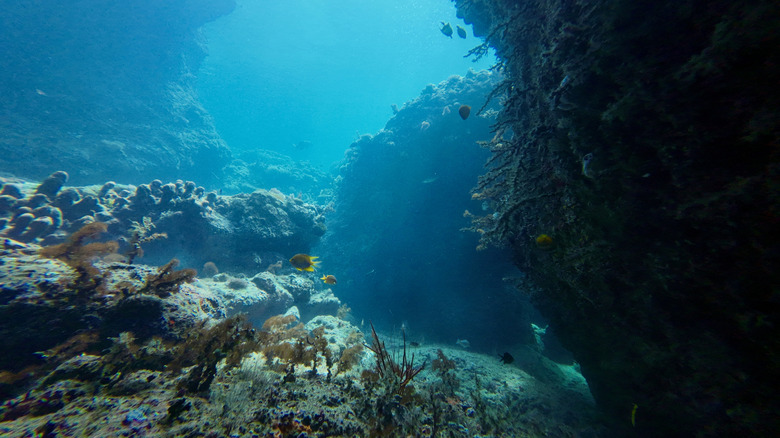
The area where the specimen was collected is on land today, but was likely beneath the surface of the ocean when the specimen was deposited, as the Nanaimo Group contains both terrestrial and marine rocks. The formation where this fossil was found was likely deep underwater at that time, making the presence of a dinosaur bone somewhat of a mystery. Scientists suspect that it was either from remains of a dinosaur that were transported by waves and currents or left behind by a scavenging dinosaur of some kind.
While the remains that formed this fossil were likely transported a good distance, the formation itself is also not currently in the same place it formed. Scientists suspect that the fossil was transported from the western margin of North America and that the Nanaimo Group was deposited at least 370 miles south of where it is today. Reconstructions of past formations using fossils, modern fault lines, and analysis of minerals like zircon that hold Earth's oldest secrets show that this formation was deposited between the latitudes of modern day Arizona and northern Oregon.
After years of searching, scientists finally found evidence of dinosaurs in a region where their fossils have been absent. This finding adds to humanity's understanding of where ornitomimosaurs lived during the late Cretaceous, though more research is needed to further clarify the range of these unusual ostrich-like creatures.