

This Lifestyle Habit Could Be Keeping Baby Boomers' Brains Sharp

As the baby boomers enter the age of retirement, many of their habits and practices have fallen under scrutiny by the scientific community. Some of their habits are healthy, while others are downright damaging. For instance, baby boomers are the last generation to widely believe in recycling. On the other hand, baby boomer's love of fast food has been linked to an expedited mental decline. Compared to earlier generations, boomers are losing their cognitive skills faster than their parents did. Yet, there's one boomer habit that may help slow down age-related mental decline: household chores.
Numerous studies have demonstrated how staying busy around the house can maintain and improve both attention and memory. For example, in a 2021 cognitive study from Singapore, researchers found that "heavy housework" significantly improved attention scores in older adults, and "light housework" improved their memory scores. In a separate 2021 study from Canada, it was discovered that physical household chores are associated with greater grey matter volume in the brains of older adults. In other words, housework helps the brain work.
Growing up in the '60s, many boomers were raised to place a strong importance on household chores. Their responsibilities included babysitting younger family members, washing cars, mowing the lawn, setting the table, ironing clothes, tending to the garden, and even polishing old chinaware. Based on contemporary ideas of success, the long list of chores was designed to teach children discipline and tidiness. Today, younger generations often regard such household disciplines as wastes of time, especially due to the rise of dual-income households and longer working hours. But boomers continue the tradition of household chores, and it may be a practice that keeps their faculties sharp.
Why household chores are good for an aging brain
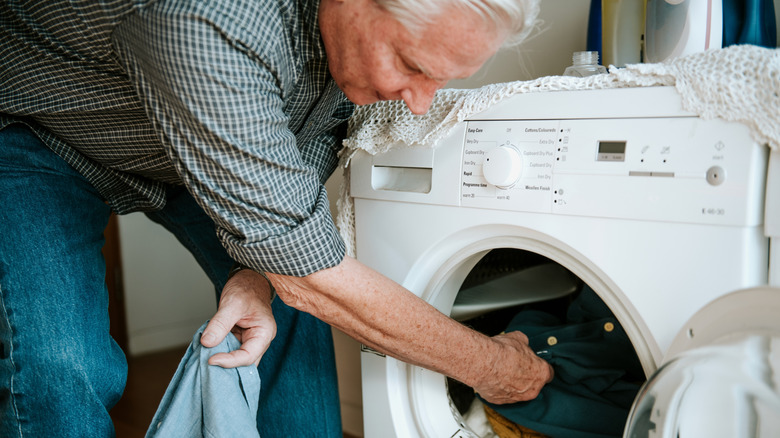
Researchers have identified three main mechanisms that drive the connection between housework and mental acuity: cardiovascular exercise, the training of the brain's cognitive executive load, and the disruption of the sedentary lifestyle. The cardiovascular benefits are obvious. Though they may not be as intense as running on a treadmill, doing chores like laundry, cleaning, and working in the garden all provide low-intensity cardiovascular exercise. Simultaneously, chores are demanding on what scientists call the "cognitive executive load." Doing chores exercises the brain's working memory, which processes the information needed in planning and prioritizing. Put simply, chores provide both physical and mental exercise.
Perhaps the unhealthiest boomer habit is the habitually sedentary lifestyle. Reared in the age of a burgeoning white-collar workforce, many baby boomers made a living sitting behind a desk and working with words and numbers. Unfortunately, this sedentary lifestyle is linked to just about every age-related disease in the book, including an early death. Ironically, baby boomers advocate outdoor play for their children and grandchildren, just as they were raised, yet they generally don't practice what they preach. Thus, household chores are one of the few boomer habits that seems to get senior citizens up off their seats.
Staying in shape both physically and mentally in old age is difficult, especially since the body starts aging faster and faster after 50. We also lose neuroplasticity as we grow older, which is the brain's ability to adapt and create new neural connections. But for baby boomers, it's never too late to start focusing on their mental and physical health. Chores may be monotonous, but they're also valuable tools for staying sharp into your twilight years.