

What Are The Health Drawbacks Of Plant-Based Meats? Scientists Are Still Debating It
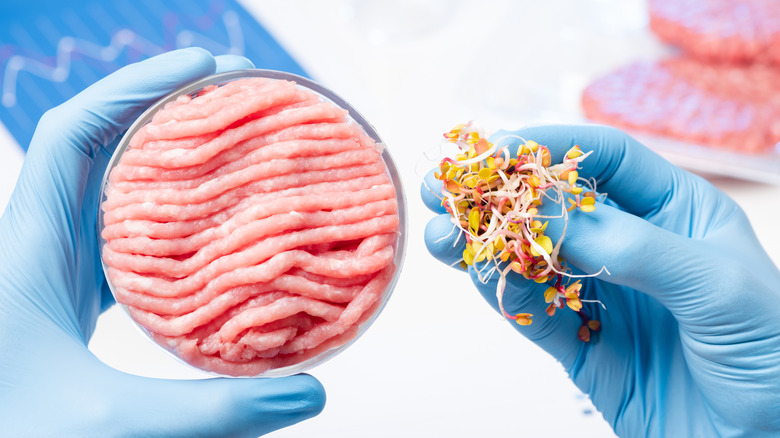
Animal meat may be a tasty source of high-quality protein, but it has its drawbacks. For starters, red meat has been linked to a medley of deadly illnesses, including cancer, heart disease, and diabetes. Then, there are the environmental downsides of meat production. Over 40% of the United States land is dedicated to animal agriculture, which includes all the cropland and pastureland we need to feed livestock. Furthermore, animal agriculture emits a staggering amount of greenhouse gases, affecting the health of local ecosystems and warming the globe. Thus, it's often assumed that plant-based meats are healthy in comparison to animal meat — but various studies have given popular plant-based meat products a mixed bill of health.
A 2023 nutritional study from the University of Brasília found that most plant-based meats are extra-high in sodium while containing comparable amounts of saturated fats as their animal-based counterparts. The high sodium content is the most immediate health concern, as some products contain up to 700 milligrams of sodium in a single serving — that's one third of your daily recommended sodium intake. For comparison, a McDonald's Big Mac contains 460 milligrams of sodium. Excessive sodium consumption has been linked to high blood pressure, kidney disease, and a lower life expectancy.
The reason plant-based meats are packed with salt is simple, though their recipes are not. Food scientists design these products to match the taste and texture of animal meat, and they often require heavy processing and chemical engineering to achieve that goal. Their protein is typically derived from processed peas, soy, and wheat gluten. To give these bland, earthy flavors a more meat-like flavor and texture, food scientists supplement the "flavor gap" with extra salt and oils. This high sodium content is the clearest drawback of plant-based meats, but it's not the only one.
Salt is just the tip of the ultra-processed iceberg

At the cost of flavor, food scientists could lower the sodium content of their plant-based meats to make them healthier, but they can't easily imitate the texture of animal meat without chemical processing. As a result, most popular meat imitations that you find in a grocery store are classified as "ultra-processed foods" (UPFs). This classification means that the products are manufactured on an industrial scale and undergo multi-step processes to isolate, extract, and modify their flavors, proteins, and starches.
Globally, UPFs are among the unhealthiest foods for your heart, responsible for increased rates of heart disease, especially in countries that consume large amounts of packaged snack foods and fast food. However, a 2022 literature review from the Soy Nutrition Institute Global argues that UPF is too broad of a term to determine whether a plant-based meat product was healthy or not. Unsurprisingly, the institute is funded by the soy industry. Still, there is some truth to the claim: many ultra-processed plant-based meats deliver comparable nutrition to their unprocessed, animal-based counterparts.
Food scientists refer to different degrees of food processing when giving a rough estimate of a food product's nutritional content, since more processing is associated with fewer complex nutrients and higher amounts of unhealthy additives, like salt, seed oils, preservatives, and binding agents. These ultra-processed ingredients can throw your gut health out of balance, too, which may increase risks of chronic gastrointestinal problems. In fact, the rise of ultra-processed foods coincides with the developmental years of Millennials and Gen Z'ers, two generations experiencing unprecedented levels of colorectal cancer. Different plant-based meats have different degrees of processing, though the general consensus among scientists is that UPFs — including many plant-based meats — are best avoided.