

King Harald Died 22 Minutes After A Lunar Eclipse Peaked. An Ancient Belief Makes The Timing Even Eerier

Tributes were made around the world on August 28 when King Harald V of Norway, the oldest monarch in Europe, died at the age of 89. He was the first Norwegian-born sovereign in 500 years and he ruled for 35 years. His peaceful death at Oslo University Hospital Rikshospitalet followed days of his health deteriorating after being admitted for fluid accumulation because of a rare blood disorder and developing an infection. What has made his death feel a little eerie to some people, though, is how close it happened to a partial lunar eclipse.
The global peak of the August 28 partial lunar eclipse (one of the general types of eclipses) occurred at 4:13 a.m. Coordinated Universal Time (UTC), with 96.3% of the moon in Earth's shadow cast by the sun. Visible across most of the Americas, western Africa, and western Europe, the peak of the event occurred at 6:06 a.m. Central European Summer Time (CEST) in Oslo, Norway. The Norwegian Royal Court reported that King Harald V died at 6:35 a.m. CEST (4:35 a.m. UTC), which means that his death occurred 22 minutes after the global peak but 29 minutes after the local peak of the partial lunar eclipse.
The timing is eerily close to ancient beliefs about lunar eclipses
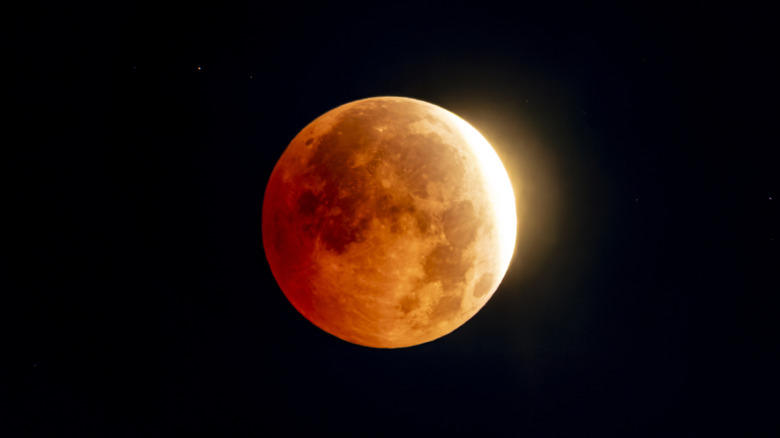
One of the weird things you probably didn't know about lunar eclipses is that many ancient cultures associated them with bad omens. Part of the reason is because many of the effects of lunar eclipses weren't fully understood. The unknown resulted in many ancient beliefs surrounding lunar eclipses.
More specifically, the Babylonians believed that a lunar eclipse meant a king will die. The translation of 4,000-year-old Babylonian tablets published in the Journal of Cuneiform Studies revealed that when "an eclipse becomes obscured from its center all at once [and] clear all at once: a king will die [...]" While the August 28 partial lunar eclipse didn't follow this exact description, the ancient omen makes it a little eerie that King Harald died so soon afterward.
Adding weight to that eeriness, untimely deaths and natural disasters have coincided with lunar eclipses throughout history. Some examples of famous deaths, for example, have included Athenian forces in a battle against Syracusan and Spartan forces in August 413 B.C.; the Byzantine Empire invaded by Ottoman forces at Constantinople in May 1453; and King Mongkut, Rama IV in Southeast Asia in August 1868.