

The US Military Is Wreaking Havoc On Coral Reefs In The Pacific - And Building Artificial Ones Closer To Home
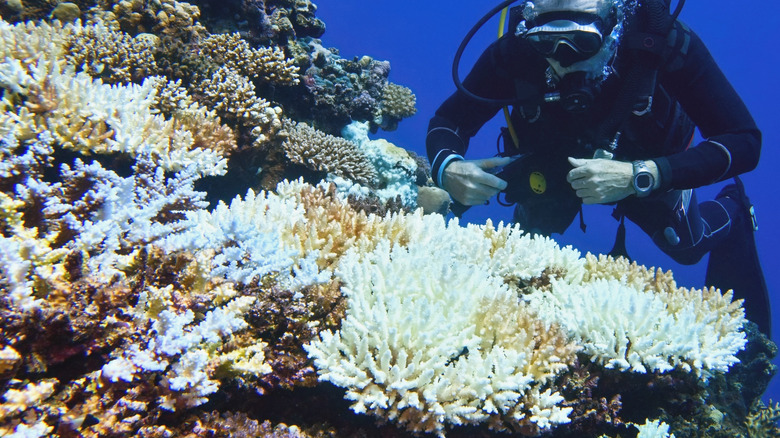
Residing in just 1% of the world's oceans, coral reefs are some of the most important ecosystems on Earth because they provide food, protection, and more for both animals and humans. In fact, the lagest underwater creature ever found is a species of coral: Pavona clavus. While global warming could have a major impact on it and other reefs around the world, it's not the only threat that they face. Another threat is the U.S. military.
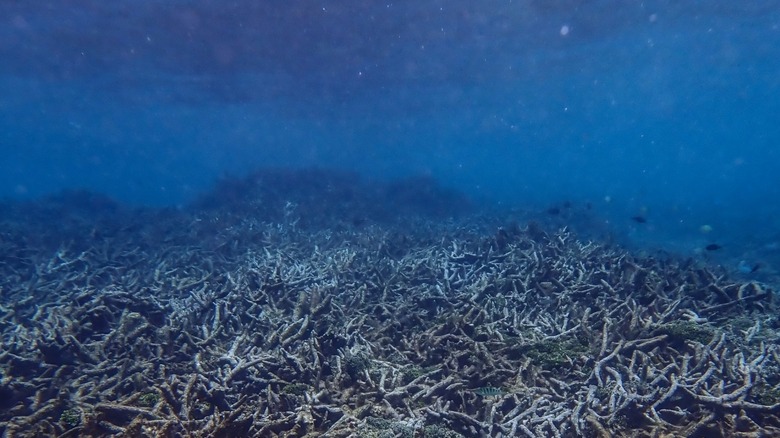
One example of this threat to coral reefs lies in the waters around Guam. Marked with Acropora — one of the most complex and environmentally sensitive coral genera — and expansive shallow-water reefs, this Pacific island territory is home to Anderson Air Force Base and U.S. Naval Base Guam. It's widely known that human activity, including military construction and projects, can destroy and smother nearby corals. And over the course of just a few years, an international team of scientists has documented a more than 50% decline in complex Acropora with low-complexity reefs and rubble left behind.
Additionally, a research paper from 2023 compared the health of local reefs before and after Guam military expansion. The results found that the 2009 base expansion resulted in declining coral reef health, triggered by increases in sea surface temperature anomalies.
Changes to the Endangered Species Act put all coral near military bases at risk
Knowing how crucial reefs are, the U.S. government and international agencies have put laws in place to protect them. One of those laws is the Endangered Species Act (ESA). While it lists more than 25 species as endangered or threatened, Acropora aren't included despite being labeled endangered. It also provides an exemption for military-controlled zones.
To make matters worse, the U.S. Navy put in a request in July 2025 to expand the exempt zone around Guam. It was denied at the time, but Executive Order 14154 (issued in January 2025) is pressuring agencies to prioritize national security (among other things). As a result, the National Oceanic and Atmospheric Administration (NOAA) has proposed changes to the ESA that would allow government authorities to bypass limits on the military-controlled zones exemption.
A letter by an international team of scientists in February 2026 highlights concerns that the proposed revisions put the coral reefs around Guam at even more risk of decline. Reporting an average 53% decline in Acropora from 2013 to 2015 as a result of thermal anomalies and urban development, the team warned that the reefs are in danger of ending up like the 2023 functional extinction of Acropora in Florida.
Doctoral fellow Colin Anthony at The University of Tokyo's Department of Integrated Biosciences said in a press release, "The United States government seems to be softening conservation policies in ways that allow companies and the military to avoid regulation." However, he noted that creating a policy that protects marine ecosystems is very difficult even without these proposed ESA revisions.
A Reefense project aims to install artificial reefs near coastal military bases
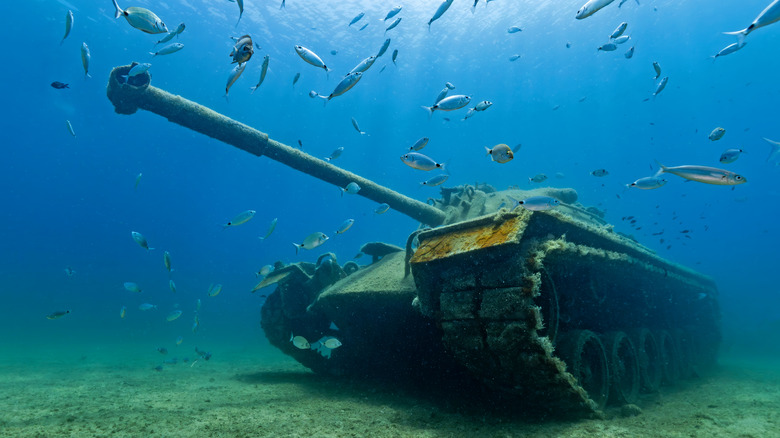
Perhaps there's a little silver lining amid scientists' prediction that Guam's coral could go extinct due to extended military activity, and it's called Reefense. Headed by the Defense Advanced Research Projects Agency, it intends to deploy artificial reefs to protect military infrastructure from crashing storm waves. That's because natural coral reefs act as buffers by weakening storm waves, reducing erosion, flooding, and property damage. The goal of Reefense is to mimic that inherent ability with artificial reefs made of concrete.
In fact, the Department of Defense manages coastal installations and more than 1,700 bases, and it can cost billions of dollars to repair severe damage. Such was the case with Tyndall Air Force Base in Florida when Hurricane Michael nearly destroyed every building in 2018. Rather than being solid like a conventional breakwater, artificial reefs are porous with holes so that the energy from storm waves can dissipate into calm water on the other side. A study published in the Proceedings of the National Academy of Sciences has already seen promising results from the 164-foot test reef installed at the Tyndall base, recording a more than 90% reduction in wave power so far.
Along with the concrete structures being self-sustaining, they'll be deployed with a biological component that facilitates coral growth in tropical waters and oyster development in temperate waters. It's not the first program to use artificial structures to promote coral growth. For example, Guardians of the Reef is behind Florida's underwater snorkel trail that's also saving the ocean's coral with artificial reefs. Meanwhile, the SS United States will soon become the world's largest artificial reef.