

Scientists Reconstructed A 1.5 Million-Year-Old Face. What They Saw Complicates Evolution.
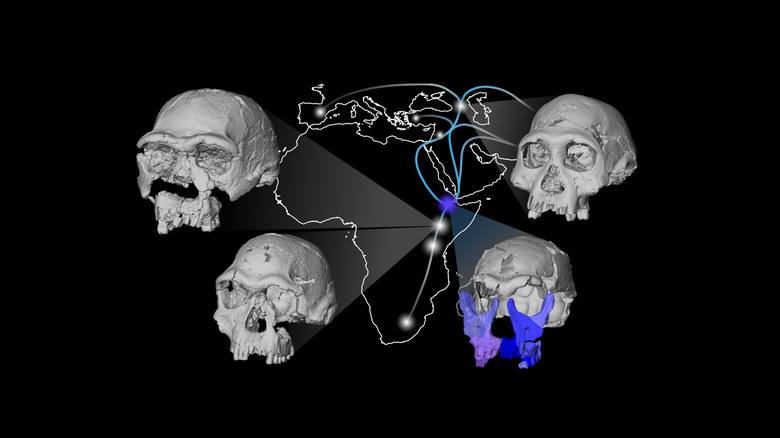
When it comes to the human fossil record, new breakthroughs often reveal more questions than answers. Thanks to advancements in computer analysis, anthropologists can take fragmented fossils and digitally fill-in the missing pieces to recreate how the fossil may have looked. Recently, this technology was used to digitally un-crush the pancaked skull of "Little Foot," a famously complete fossil from an ancestor of Homo erectus. And in 2025, researchers used it to reconstruct the face of a 1.5-million-year-old H. erectus based on a few teeth and skull fragments, revealing a far more primitive-looking creature than the researchers expected.
The fossil, called DAN5, is composed of five teeth and five skull fragments. Using micro-computerized tomography, the researchers scanned each piece to generate detailed 3D models. These models could then be manipulated to determine their original orientation. From there, reconstructing the rest of the face is straightforward albeit meticulous. For example, to reveal a missing left molar, the right molar simply has to be mirrored to the other side of the jaw. The curvature of the skull and cheekbones were also extended according to their angle of curve.
When the model was complete, two unexpected features stood out. Its nose was flatter and wider than that of other H. erectus models from the same general time period. Its large, flat molars were also peculiar — they appear more closely akin to those of H. habilis, an older human ancestor. Other features, however, were more in-line with the adaptations that connect us with H. erectus, especially its large brain case. This mixture of earlier and later features suggests that the line between early human ancestors and H. erectus wasn't straight but more of a complicated zig-zag.
The complex, interwoven branches on the human family tree
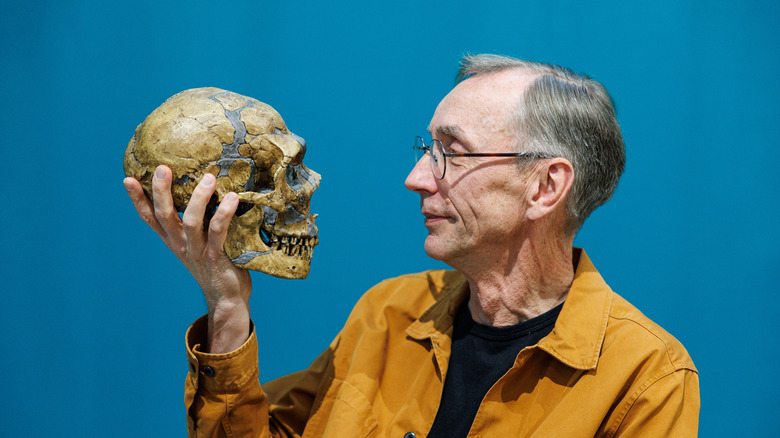
Human beings are great apes that evolved from earlier apes, which means we're taxonomical cousins with orangutans, gorillas, chimpanzees, and bonobos. But to run a complete ancestry test on our ape cousins would be futile, since evidence of direct parenthood only goes back a few thousand years. Thus, anthropologists turn to the fossil record, but this too loses sharpness the further back in time you go. Complicating the endeavor further, the fossil record is rife with different hominin species that went extinct, some of which diverged from our ancestral line only to interbreed with our ancestors later on.
This interbreeding can be found directly through DNA, as evidenced by the presence of Neanderthal genes in many people of Eurasian descent. The oldest human DNA ever extracted from a fossil is between 300,000 and 400,000 years old, so earlier fossils must be compared morphologically to study their genetic relationships. By comparing the age and shape of fossilized bones, anthropologists are able to construct a remarkably accurate timeline of our morphological evolution. Yet, while this record paints a sharp picture of the shape of human evolution, the genetics of earlier species can only be guessed at by comparing morphologies, carbon dating, and the geographic sites where they were found.
When the 1.5-million-year-old DAN5 fossil was reconstructed, researchers expected to find the same features that tracked with the contemporary models of our morphological evolution. But they didn't. Because DAN5 had features that corresponded to both later H. erectus fossils and earlier H. habilis fossils, it paints a complicated picture of our evolution, one in which evolving populations merged, diverged, and remerged to produce the apes of today — including us.