

Not Hair, Not Skin: Scientists Say This Body Part Is A Quiet Indicator Of Good Health

Assessing your health requires more than just one single test. A healthcare professional can consider certain metrics to help determine the state of your overall health, but there's also physical signs that may provide some clues. For example, your fingernails can be a great indicator of health on the outside of your body, while your oral health can also affect your heart health. Although often overlooked, your tongue is part of your oral health, and it can also be a quiet indicator of good health. So before you dismiss abnormal patches, cracks, bumps, or discolorations, know that some of these can be related to certain vitamin deficiencies, infections, and illnesses you might want to discuss with a doctor.
First, it may be helpful to understand what a "healthy" tongue ought to look like. Harvard Health describes a healthy tongue as one that is symmetrical and round in shape, and it may have a thin white keratin-containing coating on top. As for color, healthy tongues are typically light pink, though it's also normal to have small amounts of brown or purple pigmentation. Sometimes the top of your tongue may change color temporarily based on some of the foods you eat. Examples include turmeric, coffee, and anything with highly-pigmented artificial dyes. A healthy tongue should also be free of painful sores or cracks, as well as chronic sores and bumps.
What a lighter or darker than normal tongue might mean

A lighter tongue with a white discoloration can be related to a variety of possible illnesses and medical conditions. One red flag is seeing thick white patches that persist despite brushing your teeth and your tongue. The first possibility is a fungal infection called oral candidiasis (thrush), which can develop when there's an imbalance of healthy microbes in your mouth due to a recent illness or dry mouth. It can also be caused by steroid inhalers or antibiotics, and it may be a recurring issue in people who smoke. Accompanying symptoms of oral thrush include white patches on the inside of your cheeks, roof of your mouth, and even along the gums or back of the throat.
Less commonly, lacy white patches might indicate lichen planus, which is an inflammatory condition that can also cause itchy bumps on the skin. Hardened patches may be linked with oral hairy leukoplakia. According to Johns Hopkins Medicine, oral hairy leukoplakia occurs in people with weakened immune systems, and is often triggered by the Epstein-Barr virus.
On the flipside, a darky and hairy looking tongue may be signs of a condition called black hairy tongue. This condition is most common in people with weakened immune systems, and can cause the small bumps on your tongue, called papillae, to grow longer strands of protein. It can also be caused by poor oral hygiene, smoking, and certain medications. Over time, foods can get caught in these strands and leave a hairy-like appearance. Sometimes black hairy tongue can be mistaken for oral hairy leukoplakia, which underscores the importance of obtaining an accurate diagnosis.
A bright red tongue or unusual sores can also be concerning
Although some people naturally have pink to light red tongues, a bright red tongue is never a sign of good health. There are a couple of possible explanations for a tongue that's turned bright red in color. One is a vitamin B3 deficiency, which can also cause your tongue to become painful as well as smooth in texture. A vitamin B12 deficiency may also lead to a tongue that turns bright red. Scarlet fever and Kawasaki disease are other possible, though less common, causes of a bright red tongue. On the other hand, a smooth, glossy-red tongue can be attributed to certain autoimmune diseases, or even a deficiency in B vitamins or iron, says WebMD.
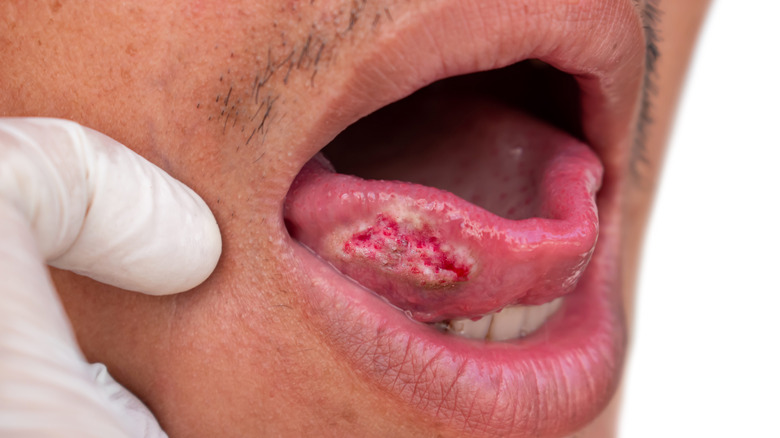
Also, while certain red, painful bumps like canker sores can resolve on their own, persistent sores may indicate something much more serious. Oral cancers can in fact cause bumps that are often painful and do not go away. According to Medline Plus, the majority of oral cancers are squamous cell carcinomas, which can affect your tongue as well as other parts of the inside and outside of your mouth. Yet another possible phenomenon is "geographic tongue," which is a harmless condition that causes painless, bright red patches that move to other parts of your tongue and creates map-like patches.
Needless to say, anything that looks out of the ordinary and lasts for more than a few days at a time ought to be checked by a healthcare professional or a dentist. Depending on the underlying cause, they may order further testing or prescribe treatment. Once the related health problem is treated, your tongue should eventually go back to its normal, healthy appearance.