

In The '50s, The US Military Had Scientists Build A Flying Saucer. They Didn't Expect What Happened Next
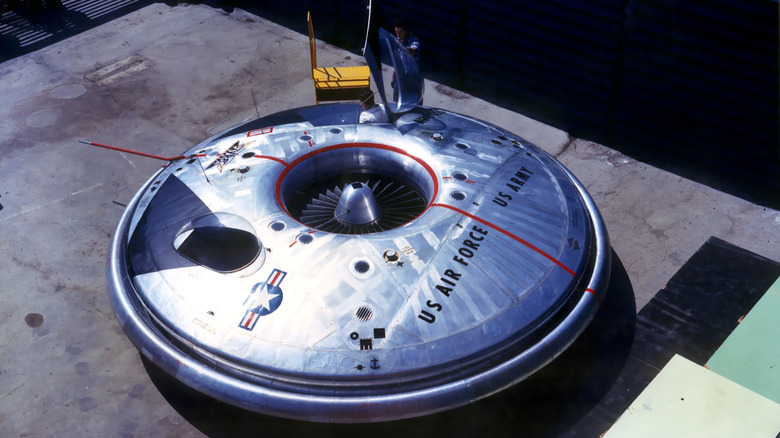
The Cold War was a weird time for science, since the U.S. government was throwing money at just about any invention or experiment that might give it an edge on the Soviet Union. Some of the more bizarre experiments included setting off a nuke in outer space, using citizens as test subjects for bioweapons, and even launching 400 million needles into orbit. That period of technological tinkering also included what can only be described as an attempt to build a real-life flying saucer, though it barely got off the ground.
In 1953, U.S. delegates were touring a Canadian aircraft plant when they were introduced to engineer John "Jack" Frost. More than an engineer, Frost was an inventor with bold yet scientifically-informed concepts. He showed the delegates his team's biggest project, a concept for a vertical-takeoff-and-landing (VTOL) aircraft. His design could fly faster than sound and hover as high as 100,000 feet above the ground. The U.S. was eager to step in and provide funding. To them, a flying saucer probably seemed too good to be true.
And it was. Frost's original design relied on the Coandă effect, which is the tendency of a gas or fluid to follow the contour of a surface rather than moving in a straight line. Frost envisioned his VTOL would direct air outward, where it would curve down along the lip of the saucer-shaped craft and lift it upwards. His design even required that the jet engine be redesigned into a donut-shape that wrapped around the pilot. But once it was time to actually build the thing, funding limitations led to compromises, and the result was two ill-fated prototypes that barely left the ground.
More like floating hubcaps than flying saucers
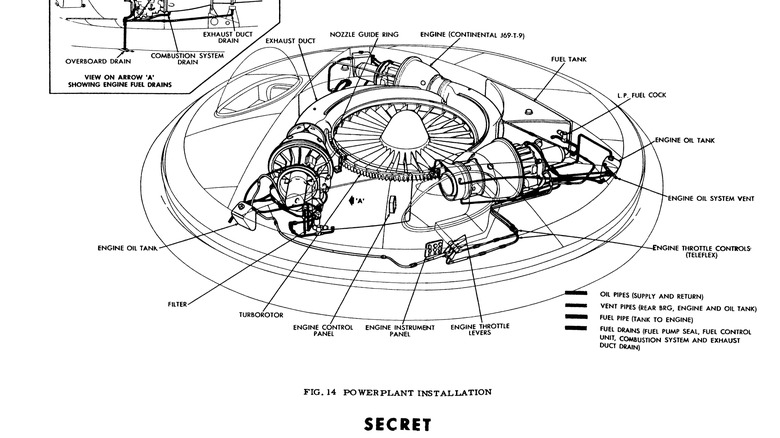
To make Frost's concept a reality, the team constructed the "turborotor" fan, which sat horizontally in the core of the disc where its air would flow through ducts to redirect it outward and along the contours of the craft. However, Frost's vision of a completely redesigned engine encircling the pilot was scrapped. Instead, the first prototype used three Continental J69 jet engines clustered around the center to power the turborotor fan. Unfortunately, this compromise introduced the first problem — they were simply too weak for the 18-foot-wide, 2.3-ton craft.
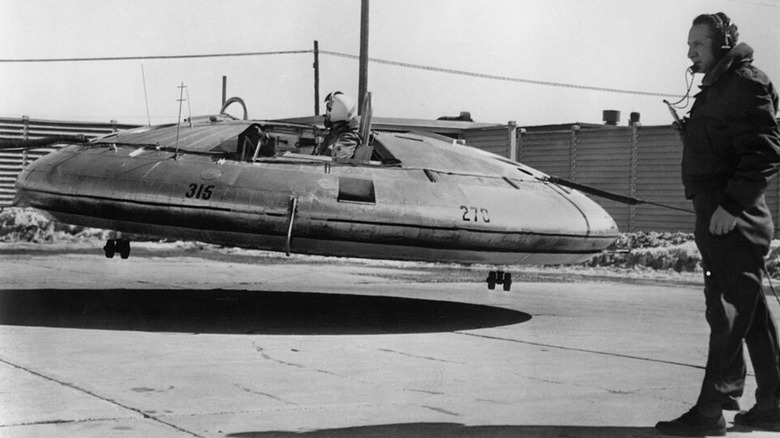
Nonetheless, the team launched the first test flight of the first prototype, dubbed the VZ-9AV Avrocar, in 1959. The craft lifted a foot or two from the ground, and then wobbled violently. Almost immediately, the pilot brought it back down as the wheels slammed and bounced off the ground. The problem was clear: The first Avrocar was aerodynamically unstable. The engineers nicknamed the Avrocar's hovering, wobbly dance "hubcapping." Later attempts to correct the wobble with a gyroscope also failed, and the project was scrapped in 1961.
Footage of the Avrocar test flights can be viewed for free on the United States' National Archives Catalog. In successful flights, pilots were able to lift a few feet off the ground and stabilize the wobble without tethers, though they struggled to turn the craft, and rising more than three feet off the ground was virtually impossible without losing control.
Why Jack Frost's flying saucer worked on paper and not on the tarmac
Today, numerous aircraft designs have employed the Coandă effect for minor vertical lift, including the Antonov An-72 and An-74 and the Boeing YC-14. However, these examples only use the effect to aid in short take-offs and landings. The Coandă effect plays a role in every aircraft's aerodynamics, but it's never been successfully used as a primary source of lift for maintaining a hover. In the case of the Avrocar, a different effect did the heavy lifting: ground effect.
Ground effect describes how gases or fluids become restricted within the space between the ground and a surface above it, creating a higher static pressure than the air above and around it. It's only significant when aircraft are a few feet off the ground, and it produces a high-pressure "cushion" of air that provides a massive amount of lift. Ground effect was the primary source of the Avrocar's lift, not the Coandă effect, and it presented a wobbly problem.
Unfortunately for flying saucers, the amount of lift from the ground effect varies with distance to the ground. So, if one side of the craft dips lower while the opposite side lifts up, the "cushion" loses its symmetry. For the Avrocar, the ground effect reached an equilibrium at around three feet where it could remain relatively stable. Any higher, and the craft was sent wobbling violently.
So if you ever get in a discussion with a UFO conspiracy theorist about mysteries science has yet to explain, you can bring up the fact that flying saucers are impractical with our current technology — the United States already tried it in the '50s.