

How Your Body Knows If You're About To Fart Or Poop

The gastrointestinal tract is a complex system of glands, nerves, tubes, and other structures that run from the mouth to the anus. Among these many parts working in tandem, those in the large intestine are responsible for, arguably, some of the grossest activities: the production, buildup, and release of gas and feces. What's amazing is that, despite gas and feces both eliciting the urge to release and "poo-phoria" — the weird thing that happens when we poop but no one talks about — your body can tell the difference. That differentiation occurs in the canal leading from the rectum to the anus.
The rectum and the canal leading to the anus are the two final parts of the large intestine. Essentially, the rectum acts as gas and poop storage, which is why the belief that occasionally holding in poop is bad for health is a common poop myth that's easily explained by science. In the canal that follows are mucous membranes (mucosas) and internal and external sphincters, which are ring-like muscles. While you don't have any control over the internal muscle, you do have control over the external sphincter — like when you clench your butt cheeks together to keep poop from coming out. Knowing all these parts is just the beginning.
When the rectum reaches a certain capacity, the internal sphincter involuntarily relaxes in what is called the rectoanal inhibitory reflex (RAIR) — part of the greater sampling reflex — to let a small amount of the contents into the canal. The mucosas and sensory nerve endings test the sample and determine if it's gas or poop (or even liquid (diarrhea)). Then, the body can decide whether to let it rip or hold back until you get to the restroom.
What happens if the body can't differentiate a fart from poop and what it means
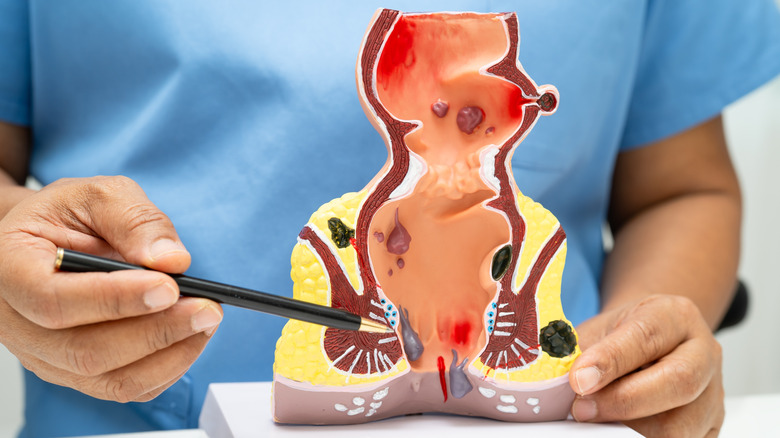
With so many parts and the nervous system working together to differentiate farts from poop and diarrhea, it's not surprising that signals can get crossed every once in a while. That mixup can lead to a shart, which is a fart accompanied by a little bit of poop that's often watery. Medically referred to as fecal incontinence or accidental bowel leakage, sharting can happen when experiencing constipation or diarrhea, while holding back a bowel movement temporarily, or as the sphincter muscles weaken with age. It's even one of the gross things that can happen if you don't poop for a week, with overflow diarrhea leaking out from behind a dry, hard stool and indicating an underlying impaction.
Generally, fecal incontinence isn't a health concern unless it's happening frequently or is severe. That's when you should see a doctor to determine if there's an underlying health issue. Among the most common are digestive tract disorders — including inflammatory bowel disease, irritable bowel syndrome, and proctitis (inflammation of the rectal lining). Additionally, neurologic diseases that impair the nerves in the canal leading to the anus — such as type 2 diabetes, dementia, stroke, multiple sclerosis, and Parkinson's disease — can result in the body confusing farts and poop. Other possible causes of accidental bowel leakage include abscesses, fistulas, hemorrhoids, and cancerous tumors.
Fortunately, healthcare providers can perform blood, stool, and urine tests — as well as bowel function tests, imaging tests, and endoscopy (a procedure to look inside the anus and rectum) — to determine the underlying cause. A variety of treatments can then be implemented depending on the results, such as bowel training, diet changes, medications, physical therapy for the pelvic floor, and surgery.