

Alaska's Strangest Animal Lives Inside Glaciers And Melts At Just 40 Degrees
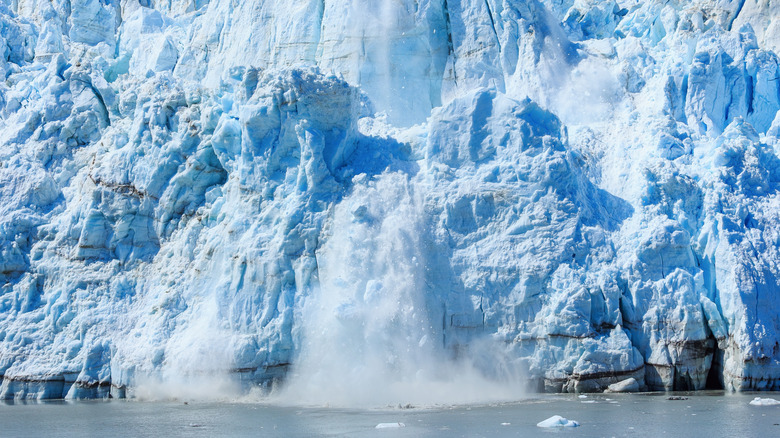
Many elusive animals have been the inspiration for legends and myths. For instance, rare giant squid sightings were the basis for the dreadful Kraken that was believed capable of sinking ships. Scientists have gathered enough evidence to prove otherwise, while the massive deep-sea creature was even detected off the coast of Australia in early 2026. Similarly, the strangest animal in Alaska has been the subject of a ballad, myths, and stories, and it lives in the state's glaciers. It's the ice worm (Mesenchytraeus solifugus).
Chunks of ice aren't as lifeless as they appear; numerous tiny organisms live on glaciers and icebergs. About as thin as dental floss and just a half-inch long, ice worms are related to earthworms, appearing dark brown to black in color, but they're smaller. What makes them so cool (pun intended), though, is that they're capable of thriving in 32-degree-Fahrenheit environments where most animals would die. That's because the ice worm has a trick up its sleeve (so to speak).
According to a study published in Evolutionary Bioinformatics, ice worms produce higher intracellular levels of adenosine triphosphate (ATP) than temperate species when the temperature drops. This special molecule is equivalent to cell energy currency, driving most biochemical reactions and regulating cell cold tolerance. The body uses ATP synthase (a complex enzyme) to make it, and further research published in The Protein Journal found that the atypical ATP production is the result of a DNA adaptation that aids the function and structure of ATP synthase. Researchers postulate that the worms stole the genetic material from high-altitude fungi in its diet.
The ice worm is so delicate that it can melt and die
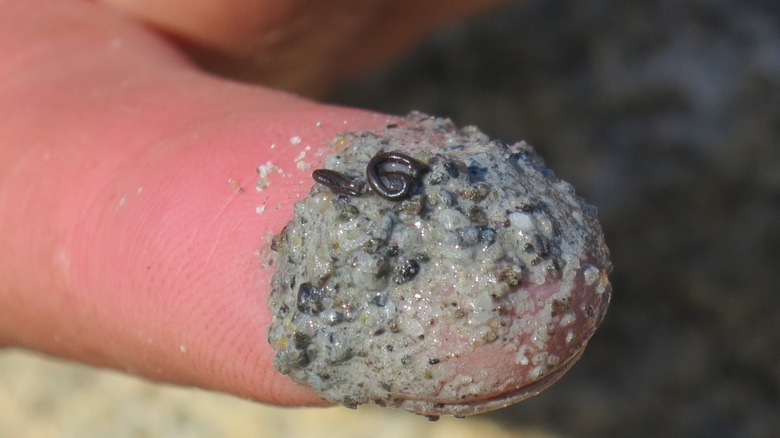
As life that scientists have discovered in an extreme environment, ice worms are up against a major metabolic challenge: The higher basal energy demands required for surviving in that ice environment. That's why the elevated ATP levels occur as temperatures fall. Despite this trick making ice worms cold hardy, these creatures have a simple but major weakness: rising temperatures. They start dying when temperatures reach around 40 degrees Fahrenheit and can begin melting from the heat in the palm of a human hand.
With that in mind, its scientific name "solifugus" makes sense because it means "sun-avoider" in Latin. It also explains the worm's behavior: borrowing deep into snow and ice when the sun is out and bright and crawling up to feed when the sun goes down. While they're deep in the ice, ice worms feed on nutrients that have become trapped in the glacial layers. They feed on algae and pollen when they surface, which also leaves them vulnerable to predatory birds, such as snow buntings. A study published in Proceedings B of the Royal Society of Publishing also found evidence that migrating birds have spread the creatures between glaciers along the Pacific Coast between southcentral Alaska and Oregon.
Back to ice worms' sensitivity to temperature, though, scientists worry that they don't have much time to learn everything they can about these strange creatures. Some glaciers where the worms have been found are gone, and the worms disappeared with them. More glaciers are shrinking, and if the melt continues at the current rate, scientists warn that the ice worms will vanish with them.