

Scientists Reconstructed A 1 Million-Year-Old Skull. They Didn't Expect What Happened Next.
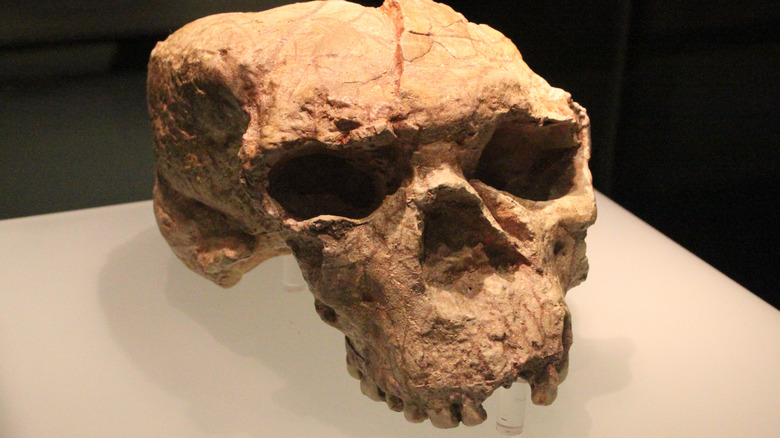
The past decade has been groundbreaking for the field of paleoanthropology. In 2025, scientists reconstructed a 1.5-million-year-old human skull and found it had a mix of different features, suggesting our ancestral line wasn't as straight as we believed. And in early 2026, researchers announced the famous 3.7-million-year-old "Little Foot" skeleton might actually be from a new branch of the human family tree. But perhaps the most groundbreaking discovery of the past decade comes from China. In a 2025 study, researchers digitally reconstructed a 1-million-year-old skull and discovered a strikingly recognizable face — pushing the split between ancient Homo sapiens and our Denisovan cousins from 400,000 years ago to 1 million years ago.
Yunxian 2 is the name given to a 1-million-year-old human fossil discovered in 1990 in China. The skull was crushed upon discovery, and science at the time wasn't capable of reconstructing it. Today, however, advanced digital imaging technology can scan the skull fragments and piece them back together. And that's exactly what the Chinese research team did. The reconstructed face was analyzed to compare its morphological and phylogenetic features with over 100 other specimens. This comparison helps researchers distinguish human species from each other and observe how they evolved.
For a long time, paleoanthropologists assumed that we diverged from our Denisovan "cousins" within the past few hundred-thousand years. But the researchers discovered something unexpected. Evidently, the ancestors of Denisovans and H. sapiens were already splitting apart over 1 million years ago, suggesting that our distinct genetic lineage is far older than previously imagined. That also means that our genetic compatibility with an entirely distinct human species remained shoulder-to-shoulder for a very long time. In other words, we mated with our evolutionary cousins.
How an ancient skull reveals the complexity of human evolution

Scientists have long been aware that the human family tree is composed of many splitting and intersecting branches, since numerous ancient human species have lived, died, interbred, and co-existed with each other. For example, the Neanderthals interbred with our ancestors for thousands of years, which is why most people of Eurasian descent possess around 1% to 2% Neanderthal DNA. And in Southeast Asia, many people have Denisovan DNA, which comes from an ancient cousin that lived roughly 400,000 to 50,000 years ago.
The 2025 reconstruction of the Yunxian 2 skull suggests that Denisovans, Neanderthals, and H. sapiens diverged more than 1 million years ago, well before their most recent "interbreeding events." This was made clear by the Yunxian 2 skull's mixture of primitive and Denisovan-like features, such as the projecting lower face, squat braincase, and larger brain capacity. These features place Yunxian 2 somewhere on the evolutionary spectrum between H. erectus and Denisovans — and they're distinct from the features of the ancient humans that would later become H. sapiens.
To the frustration of skeptics, denialists, and the researchers themselves, new discoveries in paleoanthropology seem to only complicate the human family tree. Yet, such complexity also throws into question our very understanding of what it means to be a distinct species. But according to the study, we diverged from Denisovans about a million years ago. This implies that our ancestors bred with entirely distinct human species and produced viable offspring.