

Ancient Roman Poop Gave Archaeologists Physical Evidence Of Something They Didn't Expect
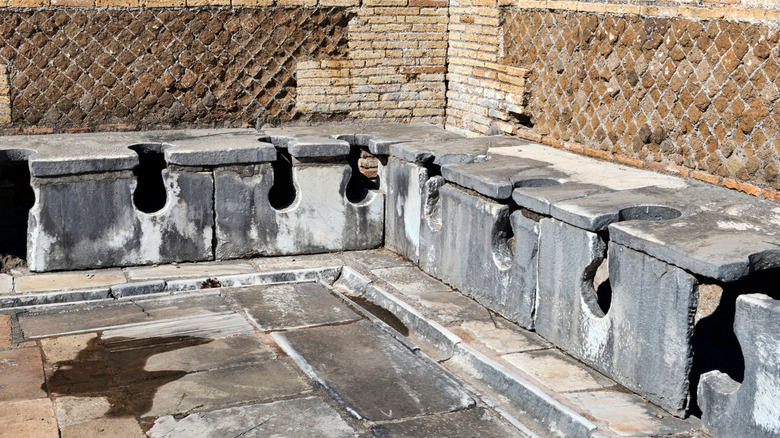
Human waste disposal and treatment has come a long way since the first clay sewage pipes were created in Mesopotamia in 4000 B.C. During the height of the Roman Empire, sanitation technology was advancing with public toilets, an impressive sewage system, and regulations for waste disposal. Archeologists thought that those improvements would have reduced the occurrence of parasitic infections. They didn't expect to find the opposite, specifically the spread of fish tapeworms (Diphyllobothrium).
In the mid-2010s, University of Cambridge paleopathologist Piers Mitchell was reviewing studies of over 50 archaeological sites in the Mediterranean area to learn which parasites were affecting humans prior to and following the Roman Empire. Publishing his findings in Parasitology, he reported that five ectoparasites (those that live on their hosts) and 12 endoparasites (those that live inside their hosts) were identified at Roman sites. Intestinal parasites like roundworms and whipworms, for instance, were present during the Bronze and Iron Age but became more widespread when the Roman Empire conquered lands. Since these parasite eggs can live in feces for a while and some farmers used human feces to fertilize crops, that practice could have contributed to the spread.
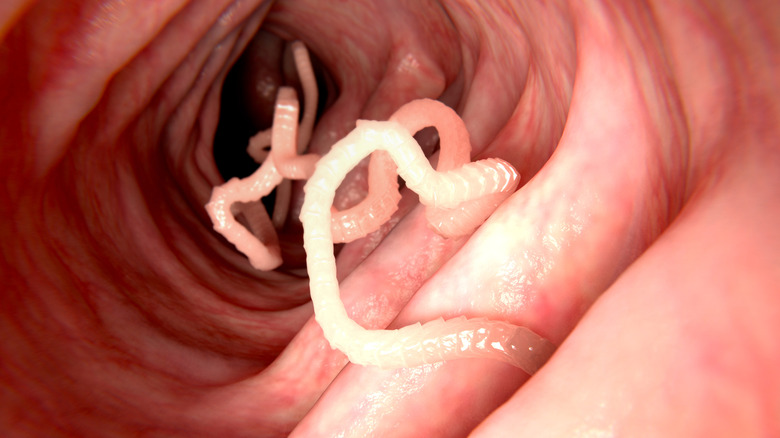
The identification of fish tapeworms (parasites that put horror movie monsters to shame under a microscope) at Roman sites in six countries was more surprising. In the paper, Mitchell explains that these tapeworms come from the parasite eggs of freshwater fish and can cause human infection when the fish isn't cooked. He surmises that the Romans' appetite for garum (fermented fish sauce) is how fish tapeworms spread across the Empire.
That's not the only surprise archaeologists have found in ancient Roman poop
Archaeologists digging at Novae (a Roman fortress near present-day Svishtov, Bulgaria) found two ancient Roman chamber pots. During an analysis of the fecal and urine residue inside, they found the oldest known evidence of Cryptosporidium infecting humans and published their findings in npj Heritage Science. More specifically, the researchers detected Cryptosporidium parvum, which is one of the leading causes of cryptosporidiosis among humans, the parasite that causes profuse diarrhea every summer. The symptoms are often mild, so scientists didn't detect the first instance of the parasite infecting humans until 1976. They've been trying to determine its origins ever since.
However, the cysts of this parasite don't usually survive in archaeological deposits. The researchers used enzyme-linked immunosorbent assay to identify it because this analysis technique only requires bodily fluid to detect bacteria, parasites, and viruses. Although the how is unclear, they think the Novae-bound Romans may have been drinking water that had been contaminated by a rural aqueduct. The infection would then trigger diarrhea in the middle of the night, so the Romans had to use chamber pots instead of the public toilets. Historian and first author Elena Klenina told Live Science, "The parasite's presence across distinct contexts suggests the infection may have been relatively widespread within that community."
At the time, the Romans didn't understand germs and parasites. Perhaps if they had, archaeologists wouldn't have found physical evidence ancient Romans were using poop for medicinal treatment.