

Archeologists Finally Have Physical Evidence Ancient Romans Were Using Poop For Something You'd Never Expect

Believe it or not, poop has its uses. For instance, scientists are using poop to save a critically endangered species from extinction. Animal feces isn't the only "waste" that's actually useful, though, as human poop can be turned into usable cooking gas. However, current-day humans aren't the first to find excrement useful. Ancient Romans, for instance, were known for using both animal and human poop as fertilizer for crops. What you might not expect is that they used both types of excrement for medicinal purposes, and scientists have discovered physical proof.
While working at the Bergama Museum in Turkey, archaeologist Cenker Atila noticed seven Roman glass unguentariums (small vessels usually used for housing oils and perfumes) with residues inside. All of them were analyzed using gas chromatography–mass spectrometry, a laboratory technique that isolates and identifies the individual components of complex gas mixtures. This was combined with a flame ionization detector, which measures organic species concentrations in gas streams.
Among the results, published in the Journal of Archaeological Science: Reports, were biomarkers for human poop. There were also traces of carvacrol, which is an aromatic compound in thyme oil (specifically Anatolian thyme) that was likely used to mask the smell. Atila said in a Reuters video interview that two amazing things have happened through this study. "Firstly, it was officially proven that human excrement was used in treatment in ancient times, that is, that it was a medicine. Secondly, we found a medicine that, whatever it is, has survived from ancient times to the present day."
Greek physicians used the medicinal poop mixture and a Roman author described it in writings
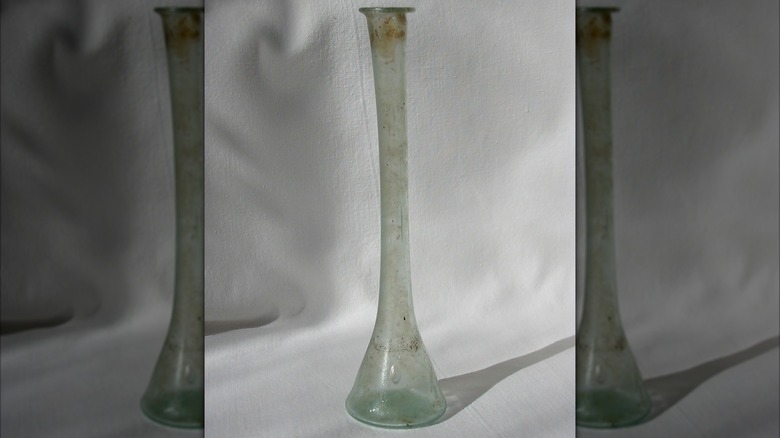
Scientists have known for a long time that poop was used in Greco-Roman medical treatments, but this study is the first time they've found concrete, physical evidence. Like fecal microbiota transplantation — which involves transferring a healthy donor's excrement to people who suffer from colon diseases to restore balance in the gut — the ancient medicine was documented and controversial. The notion sounds repulsive but has some merit considering that capybaras eats their own poop for the extra nutrients it contains.
During antiquity, at least two Greek physicians wrote prescriptions involving poop: Galen of Pergamon and Pedanius Dioscorides. Study co-author Ilker Demirbolat told Reuters that the physicians noted the gross factor in historical records. "Therefore, mix it with something that smells nice. And indeed, we found trace amounts of thyme oil in this human fecal residue." In fact, the combination found in the unguentarium matches Galen's prescriptions. Classical records also indicate that, although the Greek physician usually specified the use of animal excrement in these mixtures, there's at least one instance in which he didn't. For that case, he specified using poop from a child who had eaten bread, lupin beans, and wine.
On top of that, Roman author Pliny the Elder recorded in "The Natural History, Book XXVIII." that Aeschines of Athens used human excrement ashes for medicinal purposes. He also describes the use of dried hyena poop in a drink to treat dysentery. While it's possible ancient physicians used the very unguentarium analyzed in the study, the scientists didn't confirm either way.