

Archeologists Finally Disproved This Popular Myth About Ancient Roman Roads
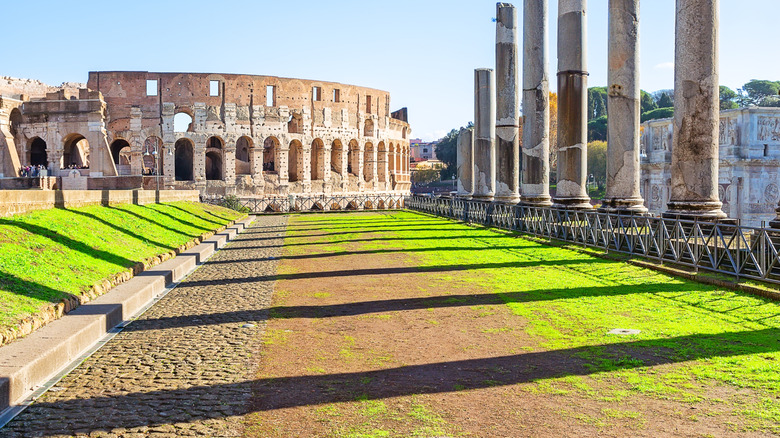
"All roads lead to Rome." This medieval proverbial phrase has been around since 1175 when French poet and theologian Alain de Lille wrote, "mille viae ducunt homines per saecula Romam," which means "a thousand roads lead men forever to Rome" in Latin. Although Alain de Lille was speaking metaphorically, it's commonly understood to reference the Empire's massive road system, which was the first continental-sized network in the ancient world. Like archeologists finally finding physical evidence ancient Romans were using poop for medicinal purposes, we now have evidence that the city of Rome didn't have the transport connections the famous saying implies.
In 2025, an international team of scientists published Itiner-e, the most comprehensive digital dataset of nearly 186,000 miles of Roman roads as they were around A.D. 150, in Scientific Data. Using that high-spatial-resolution model, some of the same researchers endeavored to answer long-standing questions about the road network and published what they discovered in Nature Communications. They converted the dataset into a network graph and found that, while Rome was centrally located on the Italian peninsula and an economic and political hub for the Empire, the city didn't have as many roads running through it as other cities. On top of that, Rome didn't even have important intermediary routes connected to it.
Where all roads actually led in the Roman Empire
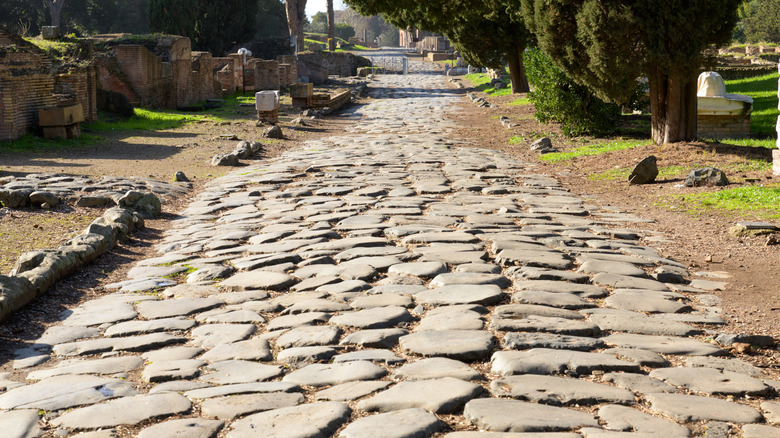
It's worth pointing out, of course, that all of the Roman Empire's roads didn't converge on one single city. However, many of the major routes connected to cities other than Rome because they were in more strategic locations geographically. One of the most well-connected was Byzantium, which was eventually renamed Constantinople (now Istanbul, where unlikely ancient ruins have been discovered) when Constantine made it the capital in A.D. 330. Although it's not clear, the scientists note in the study that he may have chosen this city because it's the only one where the road system connected to both Asia and Europe.
Byzantium wasn't the only roadway hub, though. The study also found that Ancyra, Antioch, and Corinth were better connected than Rome because of the terrestrial mobility of their surroundings and their proximity to other destinations. For instance, Ancyra was an important gateway to Anatolia, while Corinth (near one of the most stunning discoveries archeologists ever found) was a vital link to the Greek Peloponnesian peninsula and beyond. Additionally, the study results found that the Empire's provincial capitals were beneficially located for the same reason. The scientists even found evidence to support that the transport network was planned and developed at a provincial level.
Despite all of these findings, it's essential to keep in mind that the study only focuses on the Empire's roads. It doesn't take waterway routes into account. Because of that, the researchers plan to add those connections, at which point it may become more apparent that Rome was better served by river and sea connections because of its Mediterranean position.