

Ancient Romans Saved Their Urine For A Surprisingly Clever Reason
According to most historians, the Roman Empire was founded in 27 B.C. and ended with the collapse of the Western Roman Empire in 476 A.D. This 500-year window of time saw the rise and fall of bold technologies and practices, including developing complex infrastructure like lengthy — albeit disjointed — highways (which weren't arranged as popular myths suggest) and large-scale aqueducts with running water (which may not have been as sanitary as commonly believed, as proved by archeologists' discovery of Ancient Roman poop). But unlike today, pee and poo didn't always go down the same drain. In Ancient Rome, urine was a precious commodity, as it could be used as an antiseptic, fertilizer, leather working chemical, and, in the cities, as a laundry detergent.
Ancient Roman cities had public laundromats called Fullonicae, where "fullers" laundered the clothing of the Roman officials, upper class, and any other paying customers. Across the centuries, the styles and trends of the clothing changed, yet the materials did not. Roman garments were typically made of wool, a textile that collected oils and grease easily. Today, we use chemically-manufactured detergents to remove grease from wool, but the Ancient Romans just used urine. Human urine contains high amounts of ammonia, which is an alkaline solvent that breaks down fats and oils.
To collect enough urine to handle the laundry demands of an entire city, Roman fullers collected urine from public urinals and jars placed in the street. This not only helped keep the streets clean, but it was also an ample source of ammonia. Of course, the Roman fullers didn't know the scientific reason why urine was so good at removing grease from wool, but the practice was nonetheless an essential urban trade with practices based on ancient wisdom.
How to clean your clothes with pee, Ancient-Rome style
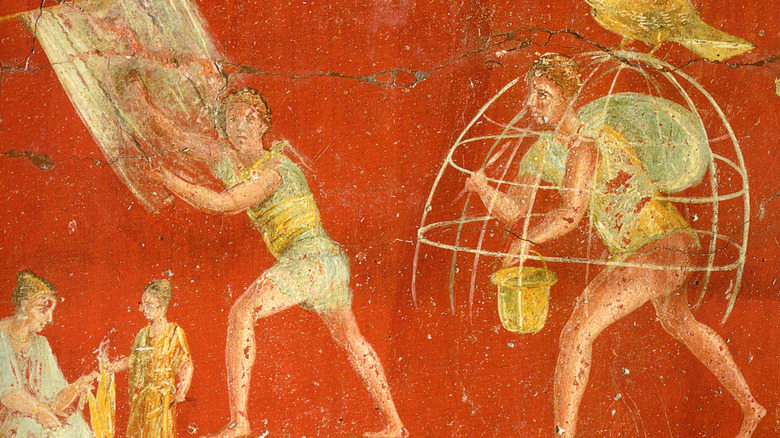
No, garments didn't leave the Fullonica smelling like pee — though the Fullonica facilities themselves almost certainly reeked of ammonia. Instead, urine was only used in the first stage and then rinsed out of the clothing. First, workers stomped the clothes in a bath of urine. With the fats broken down, the garments were then rinsed repeatedly with flowing water from aqueducts or other water sources to remove the stinky ammonia, grease, and dirt. Some Fullonicae took it a step further, by dabbing or covering the garment in "Fuller's earth," or "creta fullonia," which absorbed lingering oils and urine. For the special customers, some fullers even offered a bleaching process, in which the clothes were dried over the smoke of burning sulfur.
Most of our information about Ancient Roman Fullonicae comes from historical texts, artwork of the time, and archaeological excavations. One of the most illustrative sources comes from Pompeii. After the Mount Vesuvius eruption of 79 A.D., the city of Pompeii was covered in several feet of ash. The event was a tragedy, but it gave modern archaeologists a time-capsule of life nearly 2,000 years ago to study. Not only have archaeologists been able to analyze the DNA of the ash-covered Pompeiians, they've also excavated 13 Fullonicae in the city thus far.
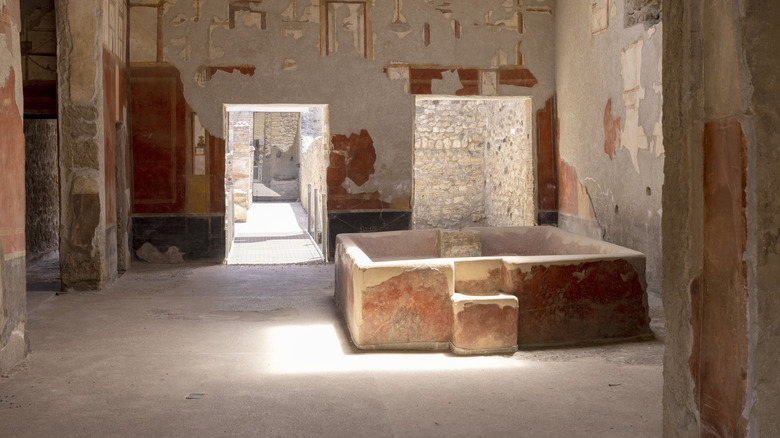
In an ongoing excavation started in 2023, archaeologists have unearthed a residential house that had been converted into a laundromat, proving that "fulling" was a business just as commonplace as apothecaries and butcher shops were. The building was equipped with a large central tub for stomping urine into clothes. Other Pompeian Fullonicae have hints of apparent drain systems connected directly to public urinals, though this is debated. In any case, you can't let all that free ammonia go to waste.