

Scientists Unearthed A Bizarre 166-Million-Year-Old Fossil In Wyoming That's The First Of Its Kind
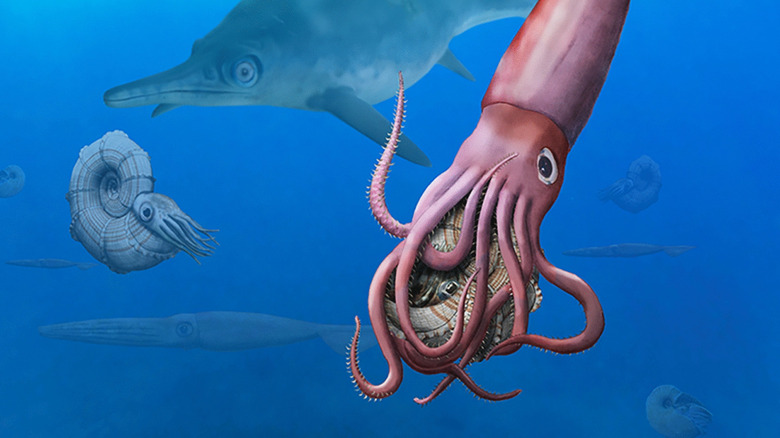
According to a 2026 study, a 160-million-year-old fossil may hold the secrets to an extinct line of squid never-before-seen by paleontologists. Not only is the specimen a unique species of belemnitid squid (a broad group of chunky squids that lived during the Jurassic), but it's possibly the only member of its genus. But it's hard to tell based on a single specimen. So, the scientists linked the fossil with another unidentified specimen that was collecting dust in a museum drawer. They realized they were looking at the only two specimens of an extinct lineage, a discovery that upended the previous beliefs about the "mega squid" family's timeline.
The fossil was named Wyoteuthis linsterorum and placed within the extinct family of belemnitids called Megateuthididae. Paleontologists have recorded Megateuthididae's presence in the fossil record for nearly 200 years, and they thought they had its timeline well-documented. Until the recent discovery, the earliest-known megateuthidid species lived roughly 200 million years ago, while the latest-known species was 166 million years old.
The researchers analyzed the megateuthidid fossil using modern biostratigraphic mapping and CT scanning to arrive at a much more recent extinction date. With an estimated age of 160 million years, W. linsterorum lived for at least 6 to 20 million years after the rest of its once-flourishing family died out.
The discovery means that W. linsterorum (and possibly its close relatives) survived as the last of their kind (similar to the living fossils of today, such as the platypus and other extant egg-laying mammals). Just as a recent Australian study suggests the existence of an entire lineage of now-extinct amphibians, this discovery points to the possibility of many more branches of the tree of life lurking undiscovered in the fossil record.
Studying a chunky squid-like creature that died 160 million years ago
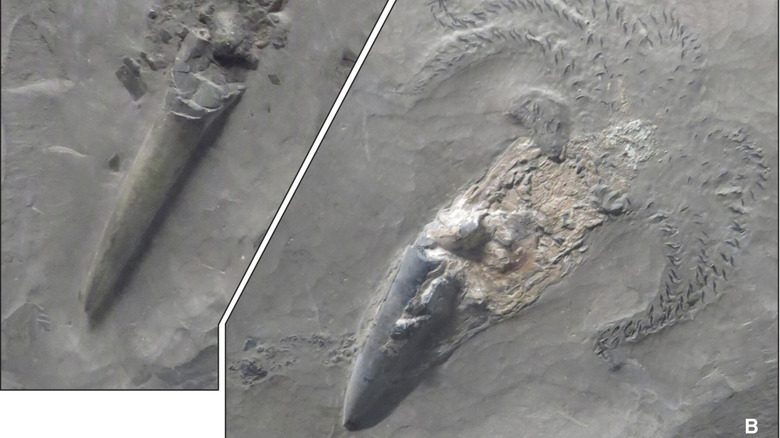
The newly-described species was part of the Megateuthididae family, a Jurassic-era group of squids who shared a common ancestor with modern squids and cuttlefish. Yet, unlike modern squids, megateuthidids left behind fossils that indicate they swam with huge, solid inner skeletons, 10 independent tentacles with dozens of hooks each, and broad heavy bodies. According to the fossil record, they didn't reach the 40-foot-plus lengths of modern giant squids, although some species measured up to 10 feet. W. linsterorum probably measured around 2 feet in length.
Perhaps the most distinguishing feature of megateuthidids were its wide, hardened rostrums. Unlike the soft skull casings found in modern squid, megateuthidids grew an extended inner cone, or rostrum, that extended around 4 inches from its brain stem. It was made of calcium carbonate, or calcite, a mineral that forms into rock-hard crystalline structures. Today, these calcite rostrums are usually the only part of the megateuthidid that survives fossilization.
Thus, their fossilized impressions look like simple cones, and paleontologists must extrapolate the rest of the information by comparing modern squid bodies with those of their fossilized cousins. They can also draw impressions of the specimen by interpreting fine, microscopic details of the fossil through CT scans, similar to the way feather impressions are visible in fossilized poop once the specimen is rendered in 3D.
It seems we've arrived at a stage in paleontological technology that surpasses the naked-eye studies of the past. Today, CT scans, advanced biostratigraphic mapping, radiological testing, and chemical analysis can provide near-exact dating of ancient fossils. This new tech tells a refined story of the history of life, and it demonstrates that undiscovered genera have lived and perished over the millennia.