

A 240 Million-Year-Old Fossil Was Found By Accident. Scientists Didn't Expect What Happened Next.
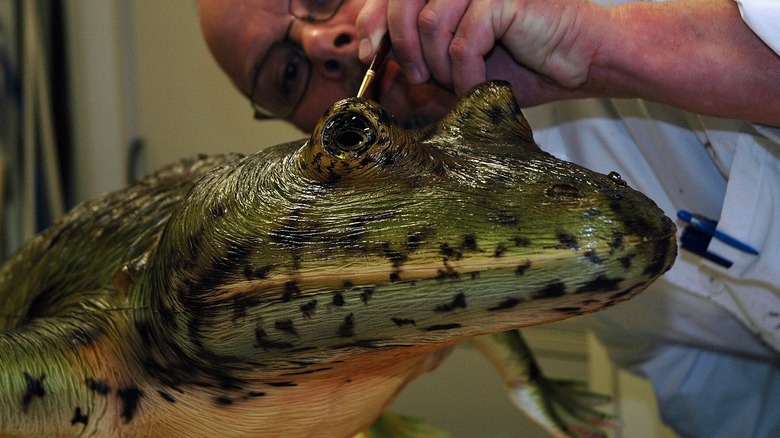
It's estimated that fewer than 0.1% of all species that ever lived were preserved in the fossil record. On top of that, finding the fossils is challenging on its own, and most specimens are degraded by the sands of time, especially the older they are. Thus, paleontologists work with a fractured and surprisingly small data set, which is why a single well-preserved fossil can completely change our understanding of our past. Recently, that fossil came from an Australian farm.
In a 2023 study, paleontologists described a unique, 240-million-year-old fossil that held the remains of an entirely unknown species of amphibian. The ancient fossil was discovered in the 1990s by Australian farmer Mihail Mihailidis while building a garden wall. He was in a prime location to find an ancient fossil. New South Wales, Australia sits atop the Triassic Sydney Basin, a layer of sandstone that began forming hundreds of millions of years ago. While washing the mud off a sandstone block, the farmer found a fossil nearly 5 feet across with the impression of what looked like a giant salamander. Mihailidis donated the fossil to the Australian Museum in Sydney in 1997.
There, the fossil caught the eye of 12-year-old Lachlan Hart. A dinosaur enthusiast, Hart eventually earned his Ph.D. 20 years later and was able to give the fossil a proper examination. He named it Arenaerpeton supinatus, or "supine sand creeper," placing it in a lonely place on the tree of life; A. supinatus was a chigutisaurid amphibian, whose family and order flourished for 100 million years before going extinct during the Cretaceous period. As the warming climate allowed dinosaurs like sauropods to take over the planet, the giant amphibians struggled to adapt.
Fossils of evolutionary lines that were severed from the gene pool
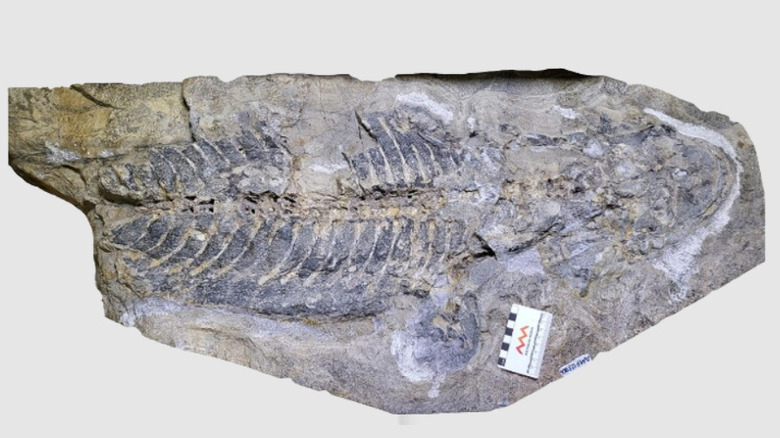
The Arenaerpeton supinatus fossil described by Hart as the "supine sand creeper" may look like that of a giant salamander, but its genetic relationship is extremely distant. It measured about 4 to 5 feet long, had a similar body plan to the modern Chinese giant salamander, and was equipped with small, sharp teeth and even pointed tusks. Although distantly related, A. supinatus and giant salamanders share features in the same way that sharks and dolphins do: Their physical similarities are more the result of convergent evolution than they are genetics.
A. supinatus' most recent common ancestor with modern amphibians died out over 300 million years ago — before frogs and salamanders even diverged — around the end of the nightmarish Carboniferous period. This means that, although A. supinatus may appear familiar to modern amphibians, it actually hails from a lineage that branched off, diversified, and then died out. Of course, its mark isn't scrubbed from the tree of life. A. supinatus' genetic order influenced the evolution of the descendants of living creatures that it competed with for millions of years, including other amphibians. This beast walked (and swam) the planet alongside the dinosaurs, and it lived in all three time periods of the dinosaurs.
The diversification and eventual death of an entire clade has occurred countless times in the Earth's evolutionary history, but the fossil record only holds glimpses of them. The A. supinatus fossil was remarkably complete, even retaining impressions of its skin, but its uniqueness hints at how much more we don't know about the history of life on Earth. Certainly, there are more fossils out there that represent unknown species, families, orders, and possibly even entire classes of extinct organisms waiting to be discovered.