

What Is Lewy Body Dementia, The Disease That Claimed Patrick Stewart And Robin Williams?

On October 28, 2026, British actor Patrick Stewart died at the age of 86 from two conditions that often occur simultaneously: Alzheimer's disease and Lewy body dementia (LBD). He isn't the only celebrity to have suffered from the latter, though. In 2014, comedian and actor Robin Williams died from suicide, but an autopsy showed that this lesser-known brain disease was the underlying cause. LBD tends to be overlooked and under-diagnosed because it shares many of the same symptoms as Alzheimer's, and there's no definitive way to diagnose it until after death. While researchers may not fully understand the disease, they've learned a lot from ongoing research.
Scientists may have finally solved a long-standing Alzheimer's mystery, revealing in the journal Cell earlier this year that the protein Arc plays a major role. However, Lewy bodies have been known since 1912 when German neurologist Friedrich Lewy first saw the abnormal protein deposits in people with Parkinson's disease. They're made of alpha-synuclein, a protein that's plentiful in the brain and involved with releasing neurotransmitters. When α-synuclein changes shape and clumps together inside neurons, it becomes toxic and prevents those neurons and other brain chemicals from functioning properly. These changes can occur in two types of LBD (the second-most common neurodegenerative dementia type): dementia with Lewy bodies and Parkinson's disease dementia. As the disease progresses, the Lewy bodies spread, as do the effects.
How LBD affects the brain and body
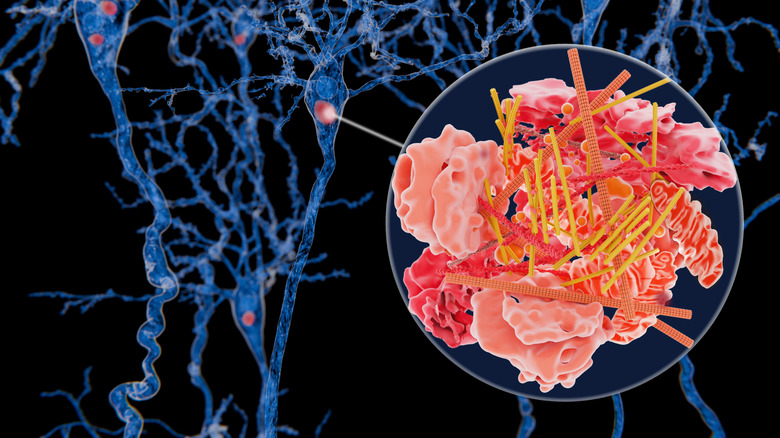
With dementia, Lewy bodies can cause wide-ranging damage to several parts of the brain. These include the brainstem, cerebral cortex (information processor), hippocampus (memory center), limbic cortex (behavior and emotion hub), midbrain and basal ganglia (movement center), and olfactory pathways (routes that transmit scent signals). Although LBD starts in these specific regions, the damage isn't limited to the inside of the brain. It can affect the nervous system throughout the body, too, including nerves in the heart, intestines, salivary glands, and sex organs.
Since LBD is a progressive brain disease, the symptoms develop slowly over time. People with the disease or their loved ones may notice behavioral and mood changes or swings, cognitive fluctuations and decline, and memory issues. The majority of patients experience visual hallucinations during the early stages, and diminished motor skills (from moving slowly and loss of balance and coordination to difficulty swallowing) and sleep disorders (from poor or excessive sleep to restless leg syndrome) can develop as well. Additionally, some people become more sensitive to cold and heat.
The symptoms can be so mild in the early stages of LBD that they don't impact everyday activities. And how fast they develop and worsen varies significantly and based on many factors (from age to overall health). It's worth noting that, when LBD occurs with Alzheimer's (known as comorbidity), the disease progression and health decline is faster. Eventually, patients may be unable to care for themselves and require full-time assistance from others.
The causes and risks associated with developing LBD

While the excessive accumulation of α-synuclein in neurons is the main hallmark of LBD, the cause of this build-up is a mutation in the synuclein alpha (SNCA) gene. This gene is responsible for providing the instructions your cells need to make the protein, and scientists have discovered at least six mutations that lead to misshapen α-synuclein, contributing to the disease's development.
Meanwhile, the synuclein beta (SNCB) gene is responsible for providing the instructions to make beta-synuclein. This protein is involved in the plasticity (flexibility) of the synapses (the structure that connects nerve cells) to adapt when necessary, and it may prevent harmful α-synuclein accumulation, too. Researchers have identified at least two mutations that lead to impaired protein production, rendering it unable to do these jobs.
Genetic mutations aren't the only risk factors for developing LBD, though. Among the 1.4 million people affected by this brain disease, researchers have found that more affected patients are men and aged 50 or older. A study published in the European Journal of Neurology found an increased risk for some types of dementia in people who are prescribed glucocorticoids (steroid medications) and NSAIDs in the 10 years prior to development. The researchers also found that old COX inhibitors (prescriptions for pain) modestly increased the risk of LBD.
Additionally, a study published in eClinicalMedicine concluded that nightmares may be a predictor of this real-life illness. Another in Neurology found evidence that the AB blood type could increase the risk of memory problems, raising the general risk of dementia. However, further investigation of LBD is needed to better identify risk factors, diagnose, and treat the disease.