

In The '60s, The US Detonated A Nuke In An Underground Salt Bed. They Didn't Expect What Happened Next
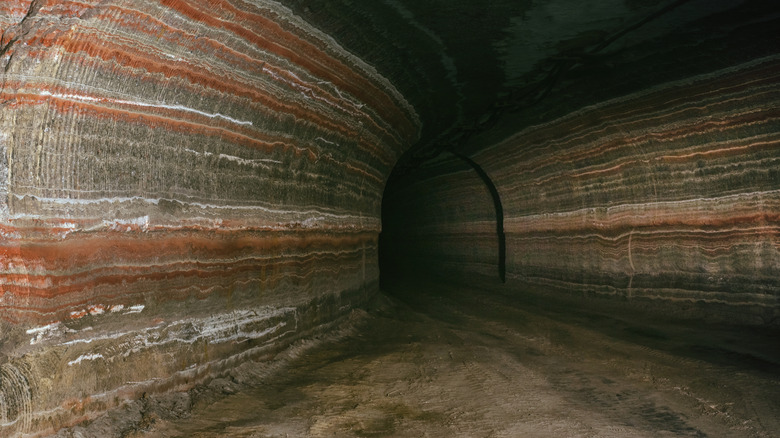
The Trinity nuclear test blast ushered in the Atomic Age with a literal bang. But, by the early 1960s, the U.S. atomic weapons program began to emphasize peaceful applications of nuclear energy. President Dwight D. Eisenhower's Plowshare program was developed to test and find these applications. The first explosion in this so-called "Atoms for Peace" program was in Gnome, New Mexico in 1961, in an underground shaft dug 1,100 feet into a salt bed. The scientists hoped to create a lake of molten salt in the blast crater. The molten salt could be used to store the nuclear blast's energy underground for later use by injecting water into the cavity and taking it out as high-pressure steam for running turbines. But the scientists didn't expect what happened next. The Gnome site's salt bed was transformed by the blast.
Underground salt beds have been a valuable resource for thousands of years. Salt can preserve food to last through a long winter, making it essential to early human survival. Today, we recognize salt domes as important oil reservoirs, and more recently molten salt has been used to store solar energy and proposed as a thermal energy storage solution for other advanced energy projects. In an ironic twist, molten salt nuclear reactors are having a renaissance moment. The Gnome scientists knew that molten salt would be a result of the blast and hoped it would be an energy storage option.
What happened at the Gnome site
Located near to Carlsbad Caverns in southeastern New Mexico, the site for the Gnome test was chosen for its remoteness from population centers. This minimized radiation exposure in case another accident similar to the Castle Bravo test. The Gnome test had four objectives, all ostensibly peaceful.
- To learn how nuclear explosions in salt beds would differ from those in tuff, the volcanic rock under the Nevada Test Site
- To measure neutron activity from the blast to help in designing nuclear reactors
- To determine if it was possible to recover radioisotopes for future study
- To create a reservoir of heat that would release slowly
The observers stationed 5 miles from the site were advised to bring binoculars, although scientists didn't expect much to be visible from the surface. They were wrong.
The first unexpected happening was the the ground heaved by approximately four feet during the blast, sending dust swirling across the ground. Viewers recalled feeling a "thump," and the resulting seismic wave cracked a gas-station wall 12 miles away. The tremors also prematurely detonated a conventional bomb at the surface, which would have been used to calibrate the strength of the underground blast. The seismic waves were detected as far away as Finland, Sweden, and Japan.
How the Gnome site was transformed in unexpected ways
The most concerning event was a plume of what appeared to be gray smoke, but which was later confirmed to be radioactive steam, that emerged from the elevator shaft used to access the salt bed. The steam had found an unnoticed fault line and made its way to the elevator shaft. It vented for approximately 30 minutes.
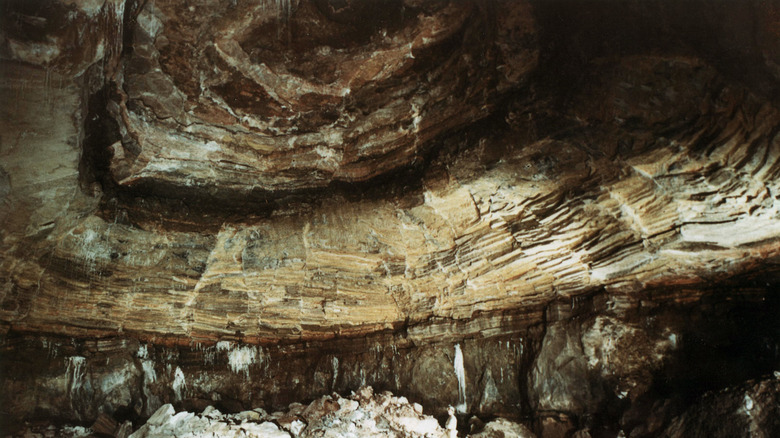
What the scientists found underground was even more unexpected. The initial results confirmed that the salt had melted, as expected. But when they entered the shaft five months later, once the radioactivity had decayed to relatively safe levels, they found that the blast's gamma rays had transformed the previously gray salt layers to vibrant shades of deep blue, yellow, and black.
The biggest disappointment was that the blast had failed to create an underground reservoir of heat, dashing hopes of a quick solution to energy storage concerns. At the time, geopolitical tensions in the Middle East made this a top issue for scientists.
Ultimately, scientists were able to salvage most of the data from the Gnome blast, despite the steam leak and premature conventional detonation. The Gnome site is now being prepared to host the Waste Isolation Pilot Plant, a potential long-term nuclear waste storage option. Nuclear waste is one of the unfortunate disadvantages of nuclear energy. Overall, nuclear energy is relatively safe and very efficient, and we have the Plowshare program to thank for its global adoption.