

Scientists Explored The World's Oldest Cave. They Didn't Expect What Happened Next
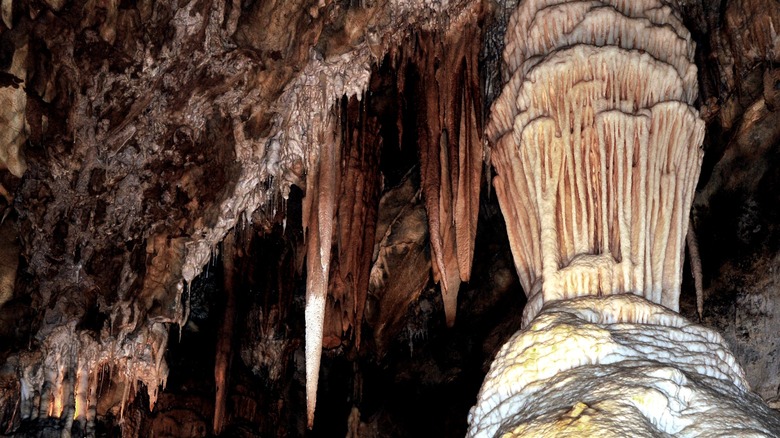
Researchers often discover things that they didn't expect when they "dig" into various facets of our planet. For instance, scientists drilled the deepest hole ever on the Kola Peninsula and found that rock deep below the surface behaves differently than expected. Naturally forming caves are just as alluring as drilling to the center of the planet. That's why researchers have continued to explore and study the Jenolan Caves in New South Wales, Australia, which has led to the discovery of more minerals than originally thought hidden inside.
The Jenolan Caves were discovered in 1838, and the first colonial exploration started the same year. While numerous caves in the system were uncovered early, a study involving researchers from the Australian Museum and University of Sydney started in 1998 and uncovered many interesting details. A paper published in the Australian Journal of Earth Sciences in 2006 revealed that the Jenolan Caves formed 394 to 258 million years ago, before dinosaurs existed, making its caverns the oldest in the world. Then in 2014, the scientists published a paper in Proceedings of the Linnean Society of New South Wales with details about all of the unexpected minerals they found.
Originally, scientists believed that the Jenolan Caves were home to a small variety of common minerals. Using an X-ray diffractometer, which combines X-ray technologies to analyze trace elements, they identified 15 minerals not previously described in the caves. Some of these are rare, such as kingsmountite, which has only appeared in one other cave environment in Mexico.
How some of the minerals formed in Australia's Jenolan Caves
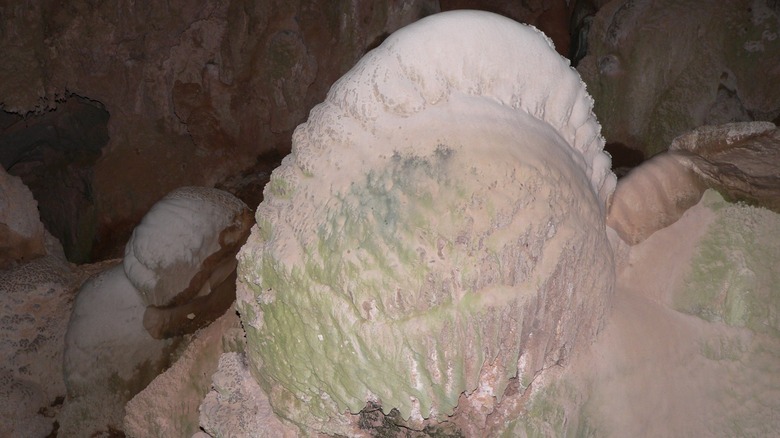
The Jenolan Caves are a system of solution caves, just like the longest cave system in the world — Mammoth Cave — in Kentucky. That means that they formed as rainwater seeps through cracks and pores in rock and soil. As the rainwater absorbs carbon dioxide, a carbonic acid solution develops and eventually eats away the thick bed of limestone, creating caverns and passageways. Similarly, the formation of stalactites and stalagmites on cave floors and ceilings is the result of dripping water and the re-depositing of calcium carbonate. However, these are not the only chemical processes that occur in caves.
Minerals are generally formed through chemical and degassing processes, but biological processes can also contribute to mineral development. During the study of the Jenolan Caves, it was discovered that the carbonate, hydroxide, oxide, and silicate groups of minerals were formed through inorganic chemical processes. However, animal poop played a part in some of the others. Feces left by the ancient bent-wing bat (Miniopterus schreibersii) interacted with the chemical composition of clay and limestone to turn into phosphate and sulfate minerals, such as crandallite and hydroxylapatite. Meanwhile, brush-tailed rock wallaby (Petrogale penicillata) poop mixed to create the chloride and nitrate minerals sylvite and niter, respectively.
Such mineral studies provide a better understanding of how and when the caves formed. For instance, scientists may have found evidence suggesting that percolating springs were behind the system's formation rather than seeping water.