

This Mysterious Ancient Roman Artifact Still Baffles Archaeologists To This Day
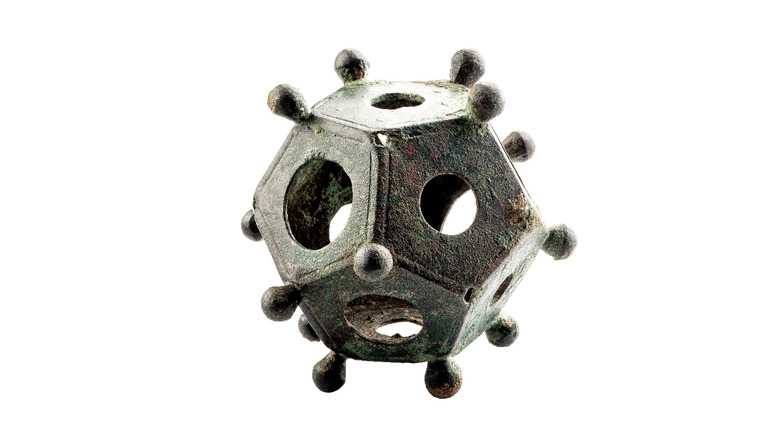
Ancient Roman artifacts are impressively advanced for their time and thoroughly confusing. The Romans were responsible for creating colossal infrastructure to advance the reach of their empire. Between their immense highway systems and self-healing concrete, they were technological pioneers. Perhaps the most perplexing Roman technology of all, though, comes in the form of palm-sized, 12-sided objects that have been found in abundance among Roman burial sites. Yet, with over 130 such dodecahedrons uncovered, scientists are still baffled about their purpose.
While their purpose remains a mystery, scientists do know a great deal about the artifacts' backgrounds. Of the 130 specimens, none come from Italy. Instead, they were found in northwestern European sites, such as modern-day France, Belgium, and Britain, and they date from the 2nd to the 4th century A.D. Although found in different places and ages, each dodecahedron shares the same characteristics: Each was handmade, expensive to own, non-standard in size, and constructed with circular holes of varying size in the center of each of its 12 faces.
The obvious explanation is that these dodecahedrons are for a dice game, like an ancient version of Dungeons & Dragons. But the facts don't support the dice theory. If the specimens were dice, it would explain the variation in size and the consistency in their balanced weight. However, unlike dice, the artifacts lack inscriptions on each face, such as we expect to see on the black dots embedded into modern dice. The 130 Roman "dice" found have no numerical, alphabetical, or symbolic markings. Evidently, these carefully constructed Roman dodecahedrons weren't used in dice games. So what were they?
The mystery of the ancient 12-sided unmarked Roman dice
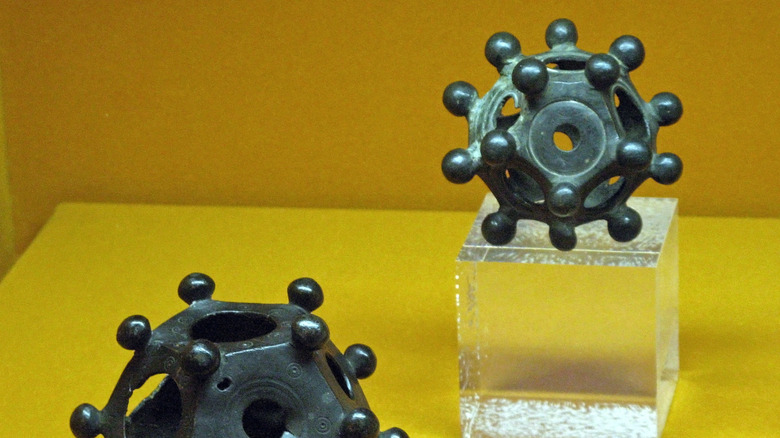
To this day, scientists can't explain the purpose of the 12-sided Roman trinkets. If these dodecahedrons served as game pieces, why do they lack distinguishing faces or wear? Furthermore, their precise construction suggests that only the wealthy could afford to have them made. Created from a bronze alloy and constructed through an expensive metalworking process called "lost-wax casting," each dodecahedron was laboriously built in stages, mostly by hand. It's unlikely that such a precious trinket would be tossed onto the street corner for the purpose of gambling.
It also appears unlikely that they were designed to be tools, since their high bronze content, which is highly malleable, means even small impacts would be enough to leave behind marks. Furthermore, astronomical and navigational tools of the time would have been designed with standardized dimensions, yet the dimensions of the 130 dodecahedrons vary wildly. Archeologists have also eliminated the knitting-tool theory, since knitting wasn't a textile technique used at the times and places where the dodecahedrons were found.
So if they weren't dice, navigational tools, or knitting tools, what the heck were they? The most popular theory is that they served an unknown religious or ritualistic purpose. Many of the dodecahedrons have been found buried alongside items considered sacred or magical. The lack of any mention of the 12-sided artifacts may even suggest that these items held a dark-magic, superstitious, or illegal status in Roman society. Often excavated and placed among other priceless treasures, the Roman dodecahedron was clearly a valuable item owned by members of the Roman elite — maybe they simply served as a token of wealth, like the modern gold necklace or fancy car.