

In The '30s, The US Military Built The First Flying Aircraft Carriers. They Didn't Expect What Happened Next.
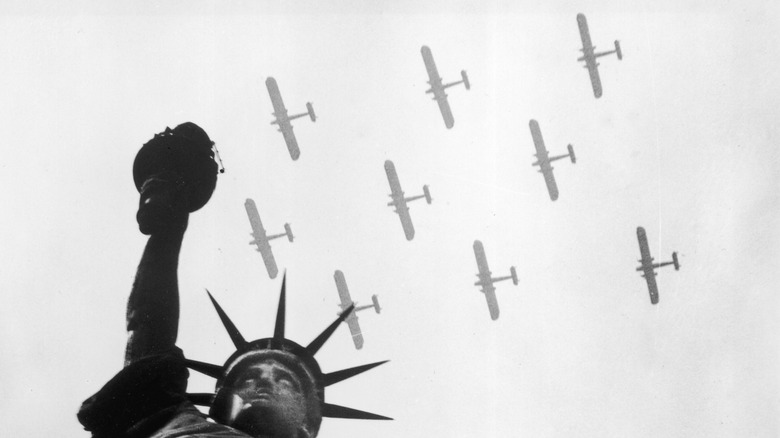
The early 1930s was a period of aviation experimentation for the U.S. military. With World War I over and tensions rising again in Asia and Europe (which led to World War II), the Navy explored unconventional designs and new ways to expand its capabilities. While Japanese military scientists were conducting gruesome human experiments with horrifying results, the U.S. was building carriers that could transport aircraft by air rather than just by sea. What they didn't expect, though, was their efforts to come to a crashing end because of the weather.
The U.S. Navy actually started experimenting with aviation capabilities in the 1910s (during World War I). However, the 1930s was the most productive when the USS Akron (ZRS-4) and USS Macon (ZRS-5) took flight. Construction on these helium-inflated airships began in 1929. At about 133 feet in maximum diameter and 785 feet long, they were designed for scouting from 5,000 feet high while carrying F9C-2 Curtiss Sparrowhawk biplanes. It's unfortunate that each of them met their doom just two years after taking flight because they encountered storms that caused unpredictable circumstances. Both landed in the ocean — one in the Atlantic and one in the Pacific. Even more tragic, though, was the loss of their crew members.
The operation and unexpected crash of the USS Akron
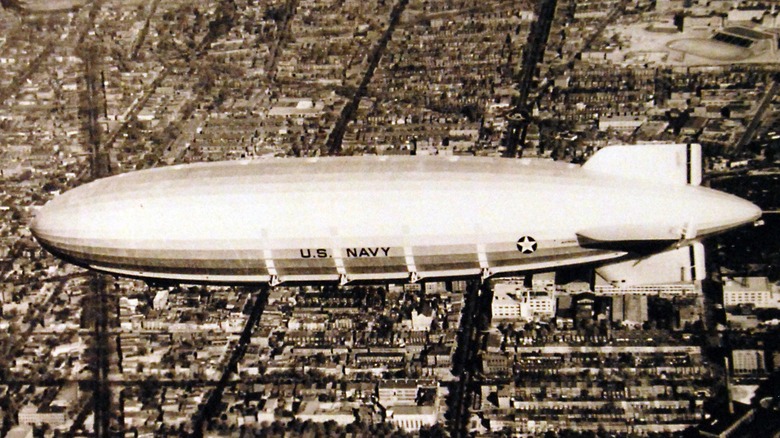
The Akron's first flight was in September 1931, and test flights were conducted for the first month before the airship was flown from its namesake home — Akron, Ohio — to the Lakehurst, New Jersey, Naval Air Station (NAS) to officially become a Navy vessel. Just a few months later in February 1932, it was involved in an accident on the ground that took two months to repair. More flight tests were performed, and later that year, the first Sparrowhawk biplane made a successful in-flight hook-on to the carrier. However, the year was also marred by the deaths of two sailors during a mooring accident as the carrier was making a cross-country journey to California.
By early 1933, the Akron had already returned to the East Coast, and operations were still being refined, with it making long-distance flights as far south as Panama. Disaster struck shortly after midnight on April 4, though, while it was en route to New England and performing a routine radio direction calibration. While over New Jersey waters, a series of powerful downdrafts and updrafts (as is common with thunderstorms) caused uncontrollable falls and rises in altitude. It fell so low that the tail struck the ocean surface during an attempt to climb, destroying the rear control system and sending the entire carrier into the water.
To this day, it's unclear whether the Akron's crash was purely caused by the storm's powerful downdrafts. It's possible that poor decisions based on inaccurate altimeter readings (an instrument that measures altitude) or other calculations by the captain were also to blame. In either case, only three of the 76 crew and passengers survived. The tragedy was compounded by the deaths of two more men when the Navy's rescue airship also crashed.
The operation and unexpected crash of the USS Macon
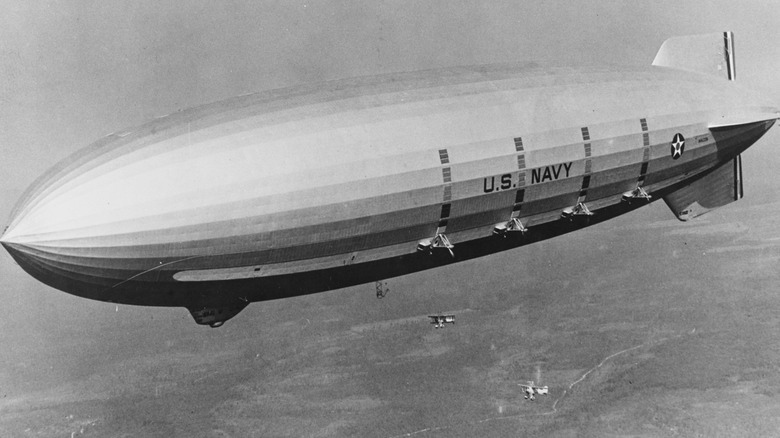
Aside from some small adjustments and enhancements, the USS Macon was built practically identical to the USS Akron, and its maiden flight occurred in April 1933, less than three weeks after the former crashed. It made the journey from NAS Lakehurst to the NAS in Sunnyvale, California, which was named Moffett Field to honor the admiral who died in the Akron crash. From there, it participated in fleet exercises over the Pacific Ocean and in the Caribbean. It didn't encounter as many accidents as its fallen sister airship, but it did suffer tail fin damage while maneuvering through rough air over Texas in April 1934.
Although three of the four fins were repaired, fixing the fourth upper fin was delayed, which contributed to the Macon's demise in February 1935. The airship was over the Pacific for an operation, and as it approached Point Sur on its way back home, it encountered a storm that caused further structural damage to the unrepaired fin and three gas compartments. As a result, a significant amount of the airship's helium was lost. It remained airborne for just over 30 minutes, but the storm's high-speed winds tore the upper fin completely off. After that, the Macon quickly rose to 5,000 feet — higher than the pressure limit — so the gas valves automatically opened to release more helium, sending the airship into an unrecoverable fall.
Only two of the 83 people on board died when the Macon wrecked into the ocean, but the Navy ended the airship project because constructing another was so expensive. While the survivors were rescued, the airship's resting place remained a mystery until 1990, and it took until 2010 for it to be added to the National Register of Historic Places.