

In 1961, A B-52 Bomber Nearly Nuked North Carolina By Accident. Here's What Went Wrong
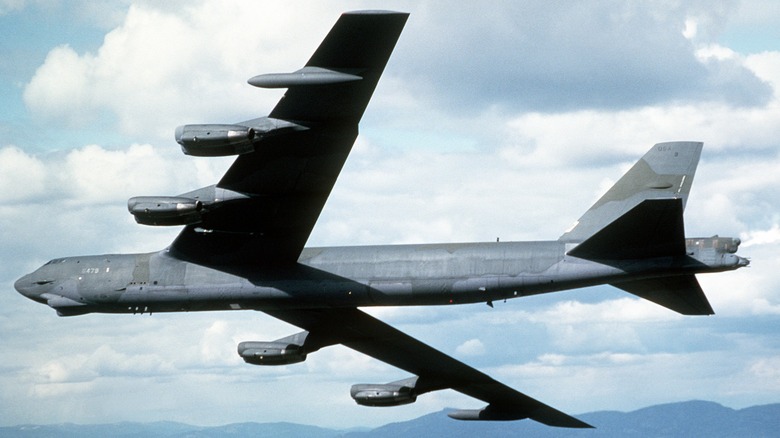
The age of nuclear bombs began near the end of World War II, and research and development has continued ever since. Starting with the first nuclear bomb detonation in the 1940s — less than a month before the U.S. military dropped two on Japan — many of those tests have gone wrong in some way. There have been several close calls involving such weapons, too. One of these occurred over North Carolina in 1961 when a B-52G Stratofortress bomber crashed near Goldsboro.
During the peak of the Cold War, the U.S. government aimed to always have an armed aircraft flying overhead, just in case. A B-52G Stratofortress was on such an alert mission on January 23, 1961. While it was refueling over South Carolina around 9 p.m., it started to sustain internal damage to the structure of the right wing. The plane remained in the air for about two hours, waiting for advice from Boeing (the manufacturer) and burning fuel.
At 8,000 feet, as the aircraft was attempting to land at Seymour Johnson Air Force Base, it broke apart and crashed about 10 miles northeast of the base shortly after midnight on January 24. Three of the eight men on board died, and two Mark 39 (MK39) hydrogen bombs fell to ground, leading to the Goldsboro incident being nicknamed "broken arrow" because it involved losing control of a nuclear device. The crash itself isn't the only thing that went wrong, though.
North Carolina's broken arrow incident was one of the closest Cold War-related near misses
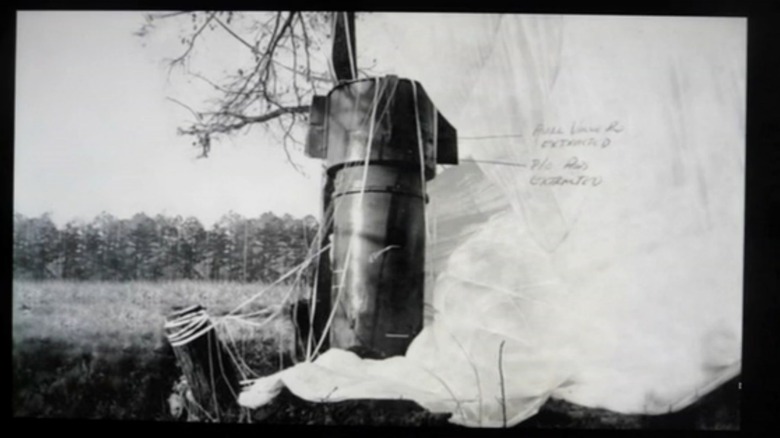
The "broken arrow" incident in North Carolina is widely considered the closest that the U.S. military came to a nuclear near miss during the Cold War era. As the B-52G fuselage or aircraft body spun toward the ground, centrifugal forces (the outward force felt on a circular-moving object) pulled a cockpit lanyard as if a crewmember was releasing the two MK39 hydrogen bombs. However, the near miss was narrowed when most of the safety interlocks on one of the bombs failed.
At the time, MK39 bombs were designed with six to eight (depending on the source) arming, fusing, and firing devices and switches that had to activate in order for the detonation to trigger. One of the bombs' parachutes didn't deploy, so it broke apart when it hit the ground after the free fall. Fortunately, the safety devices remained intact. The other bomb landed with minimal damage, but all except one of the safety interlocks activated and a firing signal was sent when the bomb struck the ground. Thankfully, the final safety, a crew-controlled switch, didn't activate.
Although officials told the local press that the MK39 bombs weren't armed, the general consensus was that they could still explode. The effects of a hydrogen bomb that size would have been devastating to the area — leveling houses within a 5-mile radius and setting ablaze houses and causing third-degree burns to people within a 9-mile radius. The area was literally saved by chance. Additionally, even though a portion of the destroyed bomb contained uranium and couldn't be recovered, the Air Force didn't detect radiation exposure.