

A Scientist Created The World's First Two-Headed Dog In The '50s. The Results Were Horrifying
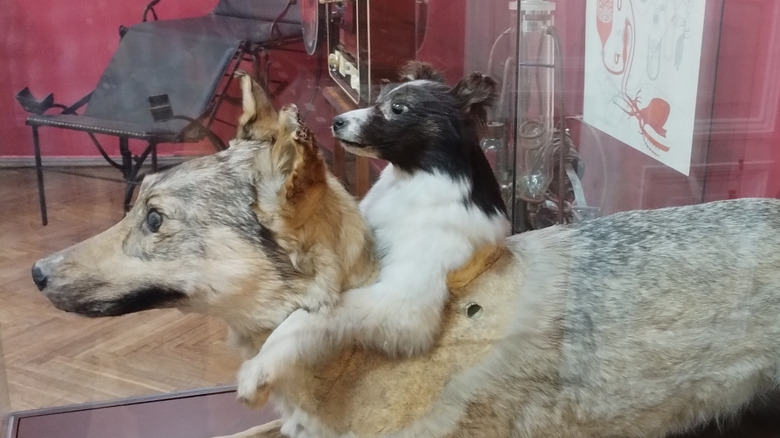
Today, most animal experiments are performed on mice and rats. Generally, the public can accept this rodent sacrifice in the name of science, based on cultural ideas of which life forms deserve ethical treatment and which don't. Modern institutions put these ethical limits in writing to prevent unnecessary suffering among even the smallest lab rats. How you define "unnecessary" suffering, however, depends on the time period in which you find yourself. Throughout history, dogs, cats, and apes, including living human beings, have served as the test subjects of medical experiments, many of which were shockingly inhumane. One of the most shocking was the "two-headed dog" experiments of Soviet-scientist Vladimir P. Demikhov in 1954, and it's hopefully the closest to a real-life Frankenstein monster that we'll ever get.
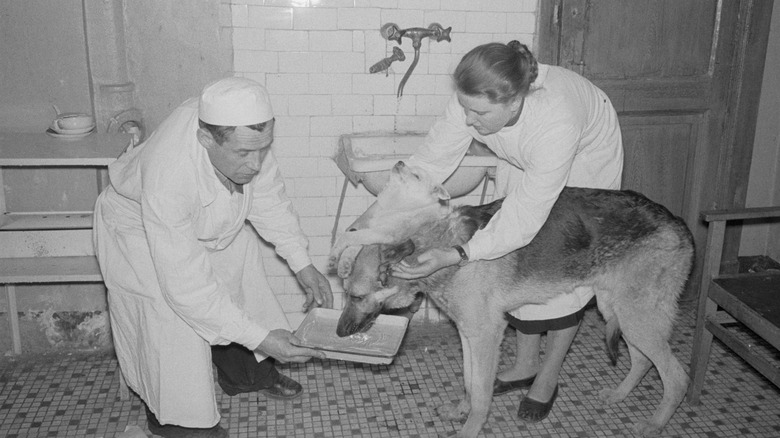
In reality, Demikhov's 1954 experiment wasn't a true head transplant, nor did it produce a two-headed dog. Instead, his experiments were more of an organ fusion of two separate dogs. First, Demikhov removed a puppy's torso below the front armpits, leaving the heart and lungs attached. He then made an incision on a larger dog and sewed the two animals' blood vessels, tissues, and skin together. The final step was to remove the puppy's heart and lungs to see if the larger dog could breathe for both brains. The result was two dogs conjoined by their cardiovascular and respiratory systems, a pitiful conjunction that survived for six days.
Over the next several years, Demikhov would go on to conduct the experiment over 20 times to improve the technique. Doing the math, we can assume at least 40 dogs went under the scalpel in total. The longest-surviving conjoined subjects lasted 29 days before they perished. For the dogs who survived the surgery, the primary cause of death was tissue rejection.
Was the Soviet Frankenstein a hero or a villain?
From his earliest academic endeavors, Demikhov was willing to sacrifice dogs in the path to making organ transplants a survivable reality for people. While attending Voronezh University in 1937, Demikhov designed and built an artificial heart, which he tested on a dog. The young Soviet scientist's machine maintained the dog's circulation for several hours before it perished. It was quite the feat for the time, and it served to lay the groundwork for later human heart transplants.
After serving in WWII, Demikhov worked in the Surgical Institute of Moscow, where his experiments advanced organ transplantation even further. Into the 1950s, Demikhov and his team performed lung, liver, kidney, and heart transplants on dogs. Most indicative of what was to come, Demikhov also experimented with "piggyback hearts," or heterotopic heart transplants, in which a donor heart is placed in parallel with the living dog's heart. This research was highly insightful and useful. The procedure was later realized in a human subject in 1974 by cardiothoracic surgeon Christiaan Barnard. Today, direct heart transplants, in which the diseased heart is replaced, are the preferred procedure, though scientists are also attempting to grow organs in a lab.
Among most medical biologists, Demikhov isn't a villain — he's a pioneer for his foundational research into organ transplantation. His methods were scientifically rigorous and meticulously documented, leading many to call him the "father of heart and lung transplantation." He even published the first modern textbook on organ transplantation, and some of his techniques for maintaining blood-oxygen levels during the transfer of a donor organ are still used today. The "two-headed" dog experiments were cruel by today's standards, but Demikhov's legacy in research likely saved more human lives than it cost in canine lives.