

Scientists Watched Frogs Freeze Nearly Solid In Alaska. They Didn't Expect What Happened Next
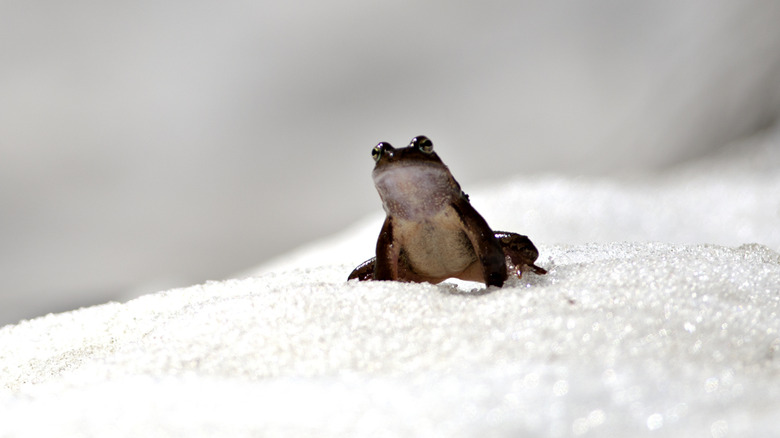
It's been a long time since amphibians were at the top of the food chain. Their domination peaked around 300 million years ago during the Carboniferous and Permian periods. This 100-million-year span of time gave rise to diverse amphibian species, and paleontologists are only beginning to uncover fossils of the vast amphibian lineages that have since gone extinct. Today, amphibians are typically restricted to smaller ecological niches. Cold-blooded and small in size, they are mostly found in warm, wet, tropical regions, such as the Amazon. But the biggest exception to the "warm and wet" rule is the Alaska wood frog. Not only is it capable of surviving the extreme cold of the Alaskan winter, but it does it by allowing about two-thirds of the water in its body to literally freeze solid.
In a 2014 study from the University of Alaska Fairbanks, researchers observed how the Alaska wood frog passes the winter unmoving and partially frozen. Over the course of the study, researchers measured temperatures that dropped below 0 degrees Fahrenheit, and all the frogs under observation survived. In fact, the monitored frogs remained frozen for around 200 days each. The researchers further observed that, once the frogs thawed out in the spring, they hopped back into life as if nothing had happened.
So how do they do it? The Alaska wood frog's strategy for surviving long Alaskan winters all takes place on the cellular level. By saturating their cells with sugar, the frogs can effectively lower the freezing point of the liquids in their bodies. This glucose saturation also prevents intercellular ice crystals from pulling water out of the cells. The Alaska wood frog evolved a system for raising these sugars levels in response to the seasonal rhythms of freezing and thawing in the Alaskan wilderness.
How wood frogs emerge from their frozen state unscathed
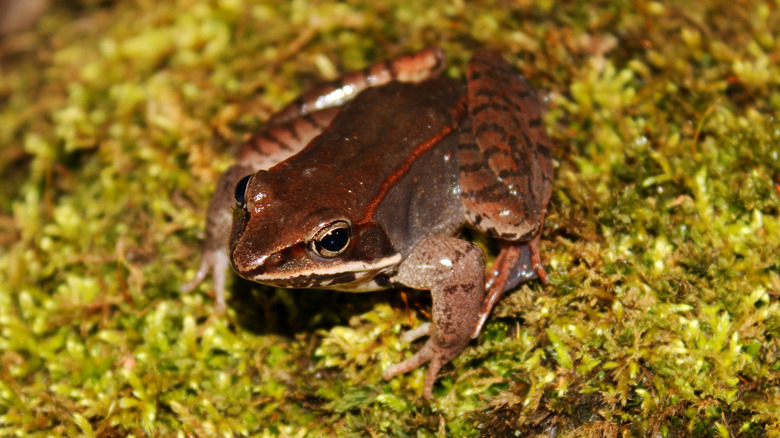
The UAF researchers observed how the Alaska wood frog responds to the natural climate of its environment. Numerous native frogs were placed under close observation over the course of the Alaskan winter. Luckily, the researchers didn't have to monitor the frogs' whereabouts — nestled on the ground under leaf litter, the amphibians literally froze into place.
In the autumn, as the days grow shorter and the nights grow colder, Alaska wood frogs freeze at night and thaw during the day. This cycle serves as a signal for the frogs to start saturating their cells with glucose. By wintertime, the frogs have already had months of increasingly cold temperatures to prepare their blood. Their metabolism slows to a standstill. Their hearts stop pumping, their breathing stops, and even their brain activity shuts off entirely for months at a time. With around 60% to 70% of the water in their bodies frozen solid, Alaska wood frogs pass the winter with virtually zero signs of life.
For most creatures, the formation of ice in the body is deadly, since the crystals can break apart cells and tissues. But Alaska wood frogs survive in one of the 10 most extreme environments where scientists were shocked to discover life. With their tissues saturated in glucose and urea (the main component in urine, which helped the Romans wash their clothes), they resist ice crystals from forming inside the cells.
Once their tissues are saturated with sugar and pee, the Alaska wood frogs can survive an Arctic winter. One specimen in the 2014 study spent 218 days in its frozen state. So, for those northerners out there who think their overwintering skills are impressive, think again.