

Scientists Explain The Mesmerizing 'Space Jellyfish' Effect That Happens After Rocket Launches
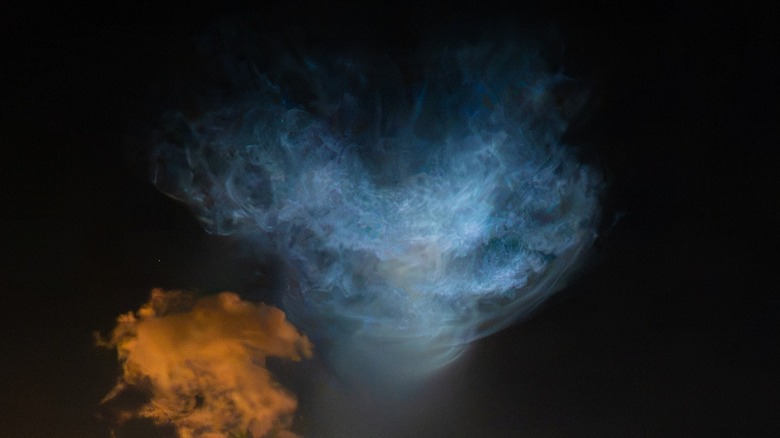
Most days when you look up at the sky, you see white to gray clouds on a background of blue. Sometimes, colorful phenomena streak across the heavens, such as the rare red rainbow or the mesmerizing "fire rainbow". The night sky can also streak with the various colors of the northern and southern lights. Unlike these effects, the "space jellyfish" phenomenon stems from a less natural source: the exhaust from a launched rocket.
The so-called space jellyfish phenomenon doesn't refer to the Jellyfish Nebula (IC 443), the remains of a supernova located 5,000 light-years away. Instead, it gets its name from the rocket exhaust plume that expands in the atmosphere and illuminates under certain conditions. Scientists have been observing space jellyfish since the Apollo 8 mission launched in December 1968. As University of Texas at San Antonio professor of aerodynamics and mechanical engineering Chris Combs explained on X, part of the reason it appears has to do with "compressible flow physics" and under-expanded flow.
Under-expanded flow means that the exhaust gases from the rocket haven't expanded in the nozzle as much as they could. As a result, their pressure upon exiting is greater than the atmospheric pressure, causing the exhaust to fan out as it leaves the nozzle, equalizing its pressure. The byproduct is a plume of exhaust left in the sky at high altitude, but that alone doesn't explain why it can glow like a jellyfish.
The space jellyfish phenomenon requires perfect timing
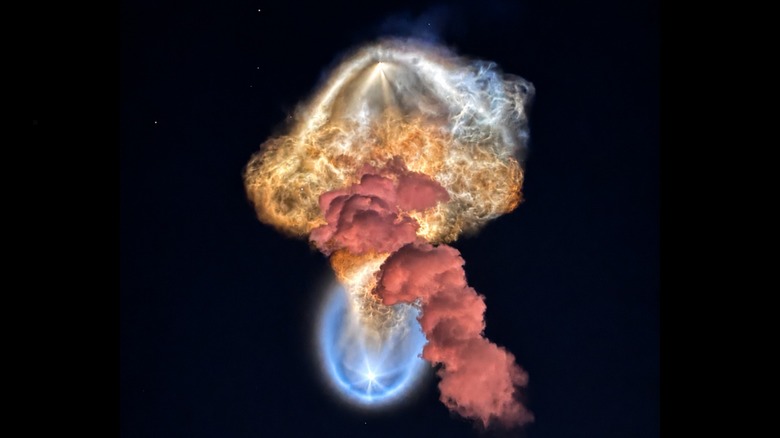
Another piece of the space jellyfish puzzle is the composition of the rocket exhaust, which is mostly carbon dioxide and water vapor but can also include aluminum oxide and soot. At such a high altitude, the water vapor condenses into tiny ice crystals as the gas–dust cloud quickly expands and cools. A similar process is responsible for creating the trails you see behind planes, which are called contrails.
The final piece of the puzzle has everything to do with the timing of a rocket launch because that affects the position of the sun and its light trajectory. For instance, one of the most recent space jellyfish occurred with the launch of SpaceX's Falcon 9 rocket on October 13, 2026 (pictured above). The rocket lifted off at 6:33 a.m. Eastern Time from the Cape Canaveral Space Force Station in Florida.
At this time near dawn, the sun is still below the horizon. While its light isn't visible to us on the ground below, it does illuminate the ice crystals in the atmosphere. The ice and particles make the sunlight scatter toward us, which makes the plume visible against the dark sky. The same can happen when a rocket is launched near dusk, and the colorful array is similar to the twilight phenomenon, when contrails are sometimes misidentified as UFOs.