


Kristine Tucker
Sciencing Editorial Policies
The unique content on Sciencing is a result of skilled collaboration between writers and editors with broad journalistic, academic, and practical expertise across the wide variety of scientific fields we cover.
In pursuit of our mission to provide accurate and ethical coverage, the Sciencing editorial team consistently fact-checks and reviews site content to provide readers with an informative, entertaining, and engaging experience. Click here for more information on our editorial process.
Stories By Kristine Tucker
-

-

-

-

Fun Facts About Science Fiction
Science fiction might not appeal to every reader or viewer, but public interest in the genre has increased. In 2008, 41.4 million TV watchers claimed to watch science fiction shows. In 2013, 47.58 million people tuned in to watch sci-fi episodes, according to Statista. The genre encompasses short stories and books, movies, television -- and sometimes even a place where science fiction intersects with science facts.
Read More -

What Is Pharmaceutical Math?
A pharmaceutical math course is often a core requirement for students who plan to pursue professional careers as pharmacists. Pharmaceutical math prepares students for performing mathematical calculations that are important to the distribution of medications. There's little room for error in this field, so pharmacists' calculations must be accurate and reliable.
Read More -

Goals & Objectives For Sixth-Grade Math
Sixth-grade math students master basic operations, such as multiplying and dividing rational numbers, fractions and decimals. They should understand pre-algebra concepts, such as solving for single variables, and know how to use ratios and rates to compare data. Goals center on students' ability to solve equations, calculate probability, estimate, measure two- and three-dimensional figures and understand relationships between numbers.
Read More -
Examples Of Real Life Probability
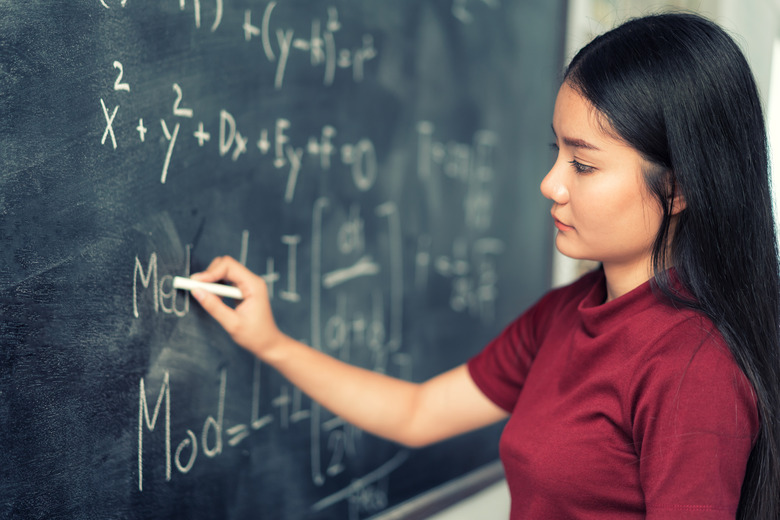
Probability is the mathematical term for the likelihood that something will occur, such as drawing an ace from a deck of cards or picking a green piece of candy from a bag of assorted colors. You use probability in daily life to make decisions when you don't know for sure what the outcome will be.
Read More -
Facts About Parallelograms
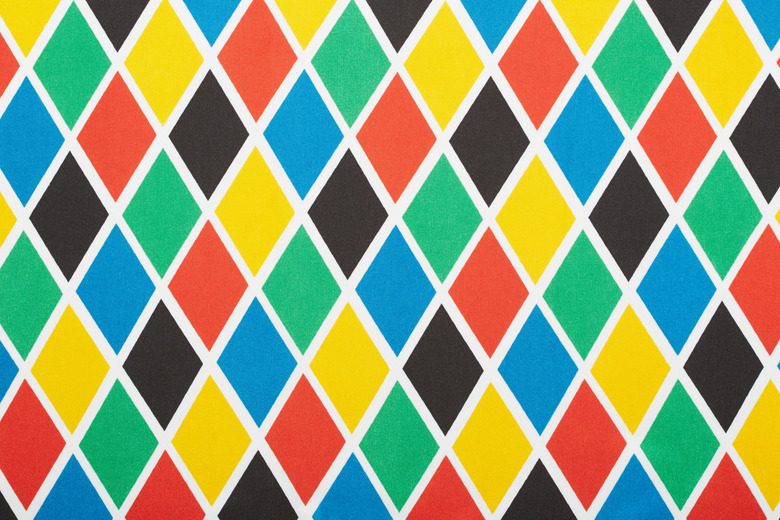
A parallelogram is a two-dimensional quadrilateral -- a shape that has four sides that intersect at four points, also known as vertices. The two opposite sides of a parallelogram are always parallel and congruent -- or equal in length. Rectangles, squares and rhombuses are all examples of parallelograms.
Read More -

What Are The Advantages Or Disadvantages Of Using The Metric System?
The metric system was first adopted in France in 1799. Most countries use this system to define weights and measurements. The United States, however, uses the U.S. Customary System of Measurements -- sometimes called English Units -- to define weights and measurements. The metric system is a decimal system, so it's easier to learn than the non-decimal U.S. system. Using the metric system has several advantages over the U.S. system, but fractions are easier with the U.S. system.
Read More -
What Are The Similarities And Differences Between A Prism And A Pyramid?
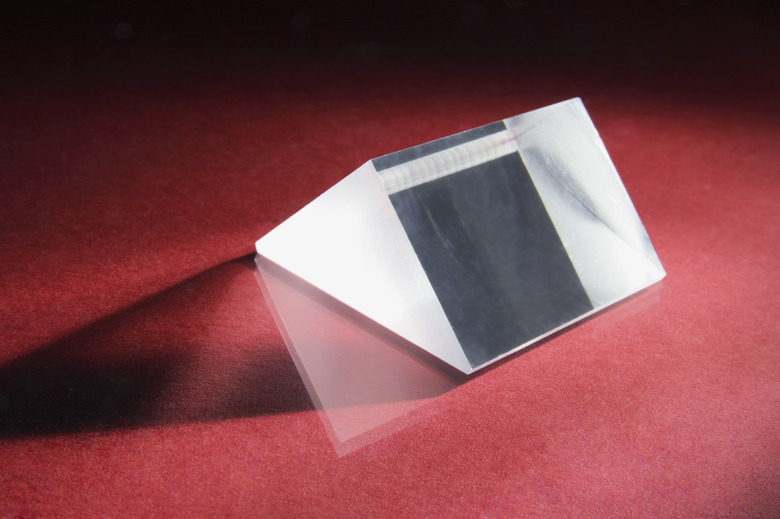
Prisms and pyramids are solid geometric shapes that have flat sides, flat bases and angles. However, the bases and side faces on prisms and pyramids differ. Prisms have two bases -- pyramids only have one. There are a variety of pyramids and prisms, so not all shapes in each category look the same.
Read More -

How To Teach Kids Even And Odd Numbers
Parents and teachers can help early elementary age children learn to distinguish between odd and even numbers, using games, manipulatives and recitation. Kindergartners and first graders can learn even and odd numbers to 10 or 20, and second and third graders can learn to identify larger odd and even numbers -- those in the hundreds, thousands or millions. Learning odd and even numbers will help students with progressive math functions such as multiplication, division and fractions.
Read More -

Everyday Examples Of Prisms
Prisms are mathematically defined as solid objects with flat sides, identical ends and the same cross section throughout the entire length of the object. Cones, cylinders and spheres aren't prisms because some or all of their sides aren't flat. There are several types of prisms, such as rectangular prisms, cubes, triangular prisms, pyramids, pentagonal prisms and hexagonal prisms. You can find prisms in everyday life in both indoor and outdoor spaces.
Read More -

Levers Used In Everyday Life
A lever is a rigid object that rests on a pivot point, known as a fulcrum. Levers make it easier to lift materials, remove tight objects and cut items. A first-class lever has a fulcrum in the center, between the effort (or force) and the load, which is the object or objects you are trying to move. A second-class lever has a fulcrum at one end and a load in the middle. A third-class lever has a fulcrum at one end and a load at the opposite end. Everyday levers help you accomplish tasks that would otherwise be too heavy or cumbersome to maneuver.
Read More -

-

Difference Between Weathering & Erosion For Kids
Weathering is the natural process that causes rock to break down over time. Erosion is the moving or shifting of those smaller pieces of broken rock by natural forces, such as wind, water or ice. Weathering must occur before erosion can take place. Fifth- and sixth-grade teachers often incorporate lessons on weathering and erosion into their science curriculum.
Read More -

The Effects Of Soil Erosion
Soil erosion is the weathering away of topsoil caused by water, wind or tillage. Pesticides and other chemicals can get trapped in soil, polluting streams and rivers as the soil breaks apart. Soil erosion can also lead to mudslides and floods, negatively affecting the structural integrity of buildings and roadways. Over time, abusive farming and agricultural tilling processes can result in nutrient degradation -- the decline in soil quality. This type of erosion depletes organic matter in soil, making it less suitable for planting and harvesting crops or for the natural production of vegetation.
Read More -
What Are The Advantages & Disadvantages Of Using Graphs In Math?
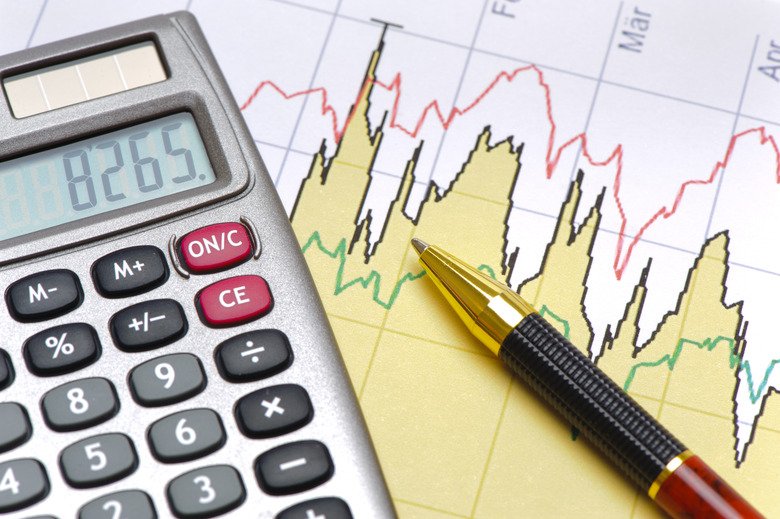
Elementary, middle school and high school teachers often use graphs as part of their math curriculum. Graphs help students organize and analyze information in well-structured formats, making it easier to interpret data. Visual learners respond especially well to graphs and often understand the information better without pages of text. Graphs do have a downside -- students might jump to conclusions without carefully analyzing the limitations and parameters. Students might also rely on graphing calculators, without being able to solve equations or do the graphing themselves.
Read More -

1st Grade Lesson Plans For Properties Of Matter
As a first-grade teacher, you can help your students understand basic principles about the properties of matter -- solid, liquid and gas -- by performing classroom experiments. Students should be able to visualize many of the differences and make their own inferences, such as that gases generally weigh less than solids and properties of matter can change by raising or lowering the temperature. Involve your students in hands-on discovery to increase their interest and understanding.
Read More


