

The Dinosaur Egg Discovery That Hid A Surprise No One Saw Coming
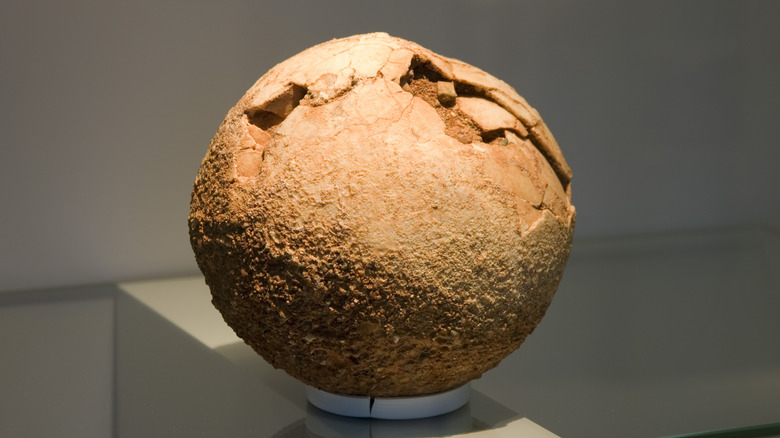
The Qianshan Basin in eastern China has provided paleontologists with an abundance of fossils from the Paleocene Epoch, the 10-million-year-long period that followed the extinction of the dinosaurs. For years, the region has produced excavators with fossilized remains of the crocodiles, birds, mammals, and reptile species that thrived after the reign of the dinosaurs ended. That's why the 2022 discovery of dinosaur eggs came as such a surprise. Not only were they the first dinosaur trace fossils found in the region, but their shelled interiors contain several astonishing, dazzling mysteries.
For starters, the fossilized eggs are geodes; from the outside they look like dirty cannonballs, while their insides are studded with dense white crystals. Dated to around 70 million years ago, the eggs would have been laid only a few million years before the extinction of the dinosaurs, during the final chapter of the Cretaceous Period, one of the three time periods that the dinosaurs lived in. This gave the grapefruit-sized eggs plenty of time to grow crystals in their interiors, though exactly through what process is based on educated guesswork.
Experts paint the geode-formation process thusly: After the eggs were laid, they were buried. It's possible the mother dinosaur buried them herself, though other geological processes like volcanic activity probably further kick-started the fossilization process. Then, their contents, including the embryonic dinosaurs inside, decayed and drained away, leaving the shells empty. From there, calcium carbonate dissolved in groundwater entered the shells by seeping in via cracks or pores. Over thousands of millennia, the calcium carbonate crystallized into the clusters of sharp-edged crystals that we see today. But more than just eye-catching geodes, the discovery holds other secrets as well. For one, the species of dinosaur that laid them is still a mystery.
More mysteries than meet the eye
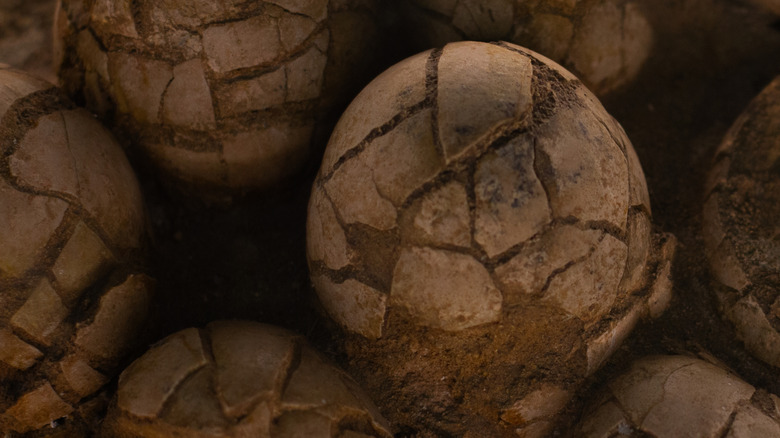
The paper describing the discovery, published in the Journal of Palaeogeography in 2022, ascribes little importance to the calcite crystals, mentioning them as little more than a physical feature of the specimens in its methodology section. Indeed, the dinosaur eggs themselves, not their crystalline contents, are of far greater interest to paleontologists. These two eggs reveal glimpses of life right before an apocalyptic event would transform the globe and pave the way for the rise of mammals. And, most remarkably, eggs like these have never been found before.
Because it's so difficult to connect fossilized eggs with the animal that laid them, paleontologists employ a different taxonomical nomenclature to describe eggs, placing them in "oofamilies" and "oospecies." The eggs found in Qianshan Basin are clearly members of the Stalicoolithidae oofamily, due to their spherical shapes and their thick, dense shells. However, the eggs have other features that have never been seen before in the fossil record, such as their notably large size, at about 13 centimeters in diameter each, and their unique microscopic structures. Thus, the new oospecies has earned a new name: Shixingoolithus qianshanensis.
To date, there have been no other dinosaur trace fossils found at Qianshan Basin (or dinosaur fossils at all). This may explain the uniqueness of the eggs' features, as they would have been laid by a Late Cretaceous dinosaur — right on the threshold of the geological layers where dinosaur species suddenly disappear. But their geological time period isn't without clues. Calcite crystals in egg fossils have been used elsewhere to learn about the geochemical environments of dinosaurs before, so further research into the mysterious Qianshan Basin eggs may help sharpen our understanding of what life was like for animals living on the brink of extinction.