

The Unexpected Body Part That Can Start 'Leaking' At Any Moment

Let's face it: The thought of any body part leaking is kind of gross. Alas, it's common for internal organs to leak fluids when they're damaged or injured, such as the bile ducts and spinal cord. Externally, edema is a condition in which excess fluid builds up in the body's tissues, leading to swelling and eventually leaking from the skin of the arms, legs, hands, and feet. One body part that you might not expect to start leaking spontaneously, though, is the belly button.
Your belly button, which is near the center of mass of your body, probably isn't a body part that you think about very much, if at all. On average, though, it's a breeding ground for more than 60 types of bacteria, according to a 2012 study published in PLOS One. It can also be home to candida yeast, which commonly grows in skin folds, such as around the underarms and groin. When too much bacteria or candida builds up, an infection develops. A green or yellow discharge that smells bad can develop with a bacterial infection, while a thick, white discharge can develop from a fungal/yeast infection (called candidiasis).
How to prevent bacterial and yeast infections in the navel
The likelihood of a bacterial or yeast infection developing in your belly button depends on a few factors. For instance, navels vary in shape and size. An infection can be more likely in an innie (concave) one because that area has tiny folds and doesn't get much air. Based on a 2019 study in the Journal of Clinical Medicine, having uncontrolled diabetes puts people at a higher risk of infection. Other risk factors include obesity, piercings, poor hygiene, and excessive sweating, such as while exercising.
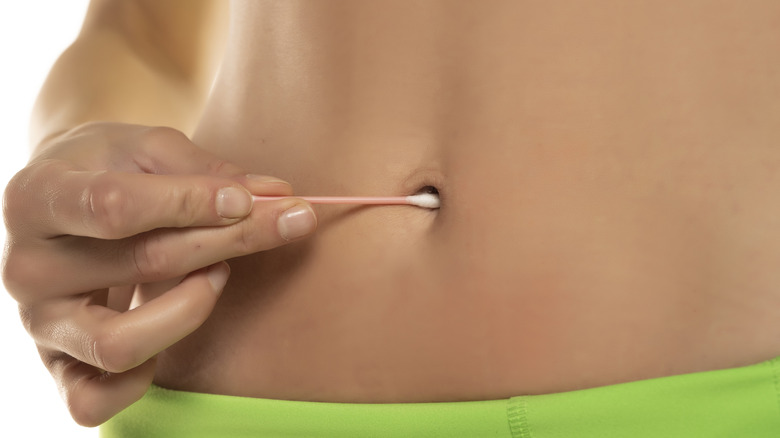
Fortunately, you can mitigate many of these risk factors by simply keeping your belly button clean. It's easiest to keep the bacteria and candida out of an outie (convex) navel. Just lather some soapy water on it with your hand or a cloth, rinse, and dry. If you have an innie belly button, you may need to use a cotton swab to wipe the inside of it clean. You can dry it with a new cotton swab afterward. Internal medicine physician Manjaree Daw explained to Cleveland Clinic, "There's no harm in cleaning your belly button daily, as long as you're not traumatizing the area by scrubbing too hard or using harsh products that irritate your skin."
Bacterial and yeast infections aren't the only causes of a leaky belly button
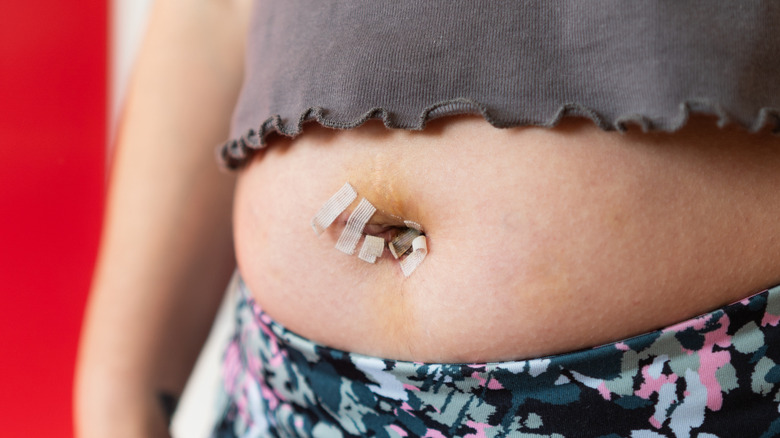
Aside from the buildup of bacteria and yeast, scratches and surgical incisions in and near the navel increase the risk of infection and eventual leakage. That's why it's so important to practice proper wound care as instructed by your physician after undergoing a procedure, such as laparoscopy for a hernia.
Although less common, a leaky belly button could be caused by one of three types of cysts, which are fluid-filled growths. A urachal cyst can form when the urachus — the small tube that connects the bladder and umbilical cord to drain urine from a developing fetus — doesn't close up as it should. While an abdominal lump and pain are possible symptoms, so too is bloody or cloudy fluid leaking from the navel.
The other two types of cysts that may cause discharge from the belly button are epidermoid and sebaceous. While both of these are fluid-filled lumps that appear under the skin, there are distinct differences. An epidermoid cyst develops when skin cells reach the end of their life and sink into the skin rather than fall away. On the other hand, a sebaceous cyst (or epidermal inclusion cyst) occurs when dead skin cells create a blockage at the top of a hair follicle (the follicular infundibulum). When a cyst is the cause of navel leakage, seeing a physician may be necessary to get antibiotics, the cyst drained and/or removed, or another form of treatment.