

The Creepy, Unsettling Nature Of Liminal Spaces Is Easily Explained By Science
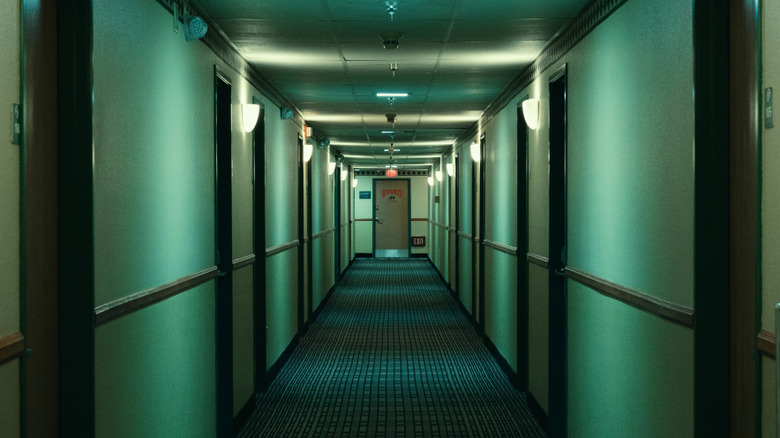
A hallway. A waiting room. An airport. An abandoned building. These are physical examples of spaces that are liminal, a term derived from the Latin word "limen" to mean threshold. Basically, liminal spaces are transition points between places or places in a state of transition, and they can even be familiar. That's not unsettling on paper, so why is it that liminal spaces seem so creepy and uncomfortable, particularly when they're empty or have strange lighting? Just like the "placebo effect" and the bizarre "nocebo effect," science has an easy explanation.
While the concept of liminal spaces isn't new, it has gained more widespread attention during the last several years. That started with "The Backrooms," an internet story that went viral in 2019. The story originated from a photo of an empty office area with fluorescent lights and dirty, yellow walls, representing the epitome of what a liminal space looks like. Dubbed creepypasta (horror content created and shared to invoke unease), that story gained momentum, leading to a series of short films called "The Backrooms" on YouTube and eventually the release of the 2026 "Backrooms" psychological thriller film.
According to researchers who published a study in Journal of Environmental Psychology, "The eeriness or strangeness of liminal spaces similarly can be explained by their deviation from otherwise typical and realistic physical places." Changes in how these places usually appear confuses the brain's perception of assurance and safety, creating a sense of discomfort and disorientation. This follows the uncanny valley theory, which is typically associated with people or people-like entities like dolls, clowns, puppets, and robots.
The concept of liminal spaces reaches beyond the physical to the psychological

When the topic of liminal spaces arises, it most often refers to physical places, however, the concept extends to the thresholds in life circumstances as well. The death of a loved one, moving to a new residence, changing careers, and having kids are all examples of transitions in life — time between an old and new story — that can deviate from typical expectations. When those circumstances invoke a sense of cognitive dissonance or feeling lost, they're considered psychological liminal phases.
Some people might seek out images, movies, and experiences that feature liminal spaces, but the feeling it provokes isn't generally sought after in everyday life. In fact, psychological liminal phases can make people feel out of control, uncertain, and like they've lost themselves as the structure of a routine falls to the wayside. That can trigger grief or anxiety for many people who may then respond by making decisions and doing things out of character to simply end the discomfort.
In regard to liminal spaces, getting rid of that unsettling feeling can be as easy as looking away or leaving the space. Addressing a liminal phase, especially a long-term one, is more difficult but possible — just like editing bad memories is no longer science fiction. The key is to practice trust, be optimistic and patient, and look for the silver lining rather than forcing expectations of what's perceived as typical. While waiting for new routines and structures to be established, liminal phases can be full of potential for personal growth by inviting self-reflection and transformation and by providing valuable life lessons.