

The Difference Between Firework Colors Is Easily Explained By Science

While the science behind some things that exist in the world can seem confusing and overwhelming, there are many things that can be easily explained — from the "old people smell" phenomenon to the "brain rot" phenomenon. The colors in fireworks are also among the many things that science can easily explain, and it all comes down to the metals that pyrotechnicians use to make them.
First, it's important to understand that firework colors are the result of a chemical reaction that produces light. Metals absorb a lot of heat energy when fireworks explode, and the raining particles emit this energy as light when they cool. The colors that you see, though, depend on the types of metals used. Some of these include four of the six alkaline earth metals — barium for green, calcium for orange, magnesium for gray and white, and strontium for red. However, it's important to note that, to get the gray and white colors, the magnesium has to be combined with aluminum and titanium.
In addition to these alkaline earth metals, fireworks use sodium for yellow and copper for blue. And since blue and red can be combined to create a lavender purple, it makes sense that copper and strontium are combined to produce lavender fireworks. It's also worth noting that while calcium alone can make orange, that color may be created by combining sodium (yellow) and strontium (red), too. On top of that, the gold sparkles in fireworks come from the combination of small charcoal pieces and iron fillings.
There is more to fireworks than the metals that produce vibrant colors
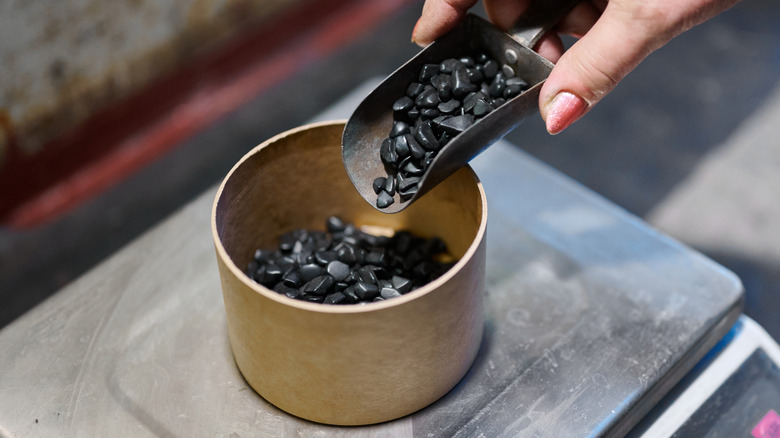
While certain metals are an essential component for giving fireworks their vibrant colors, they aren't the only component. The main ingredient that pyrotechnicians use is black powder, which is a type of gunpowder. Made of sulfur (10%), charcoal (15%), and potassium nitrate (75%), it's placed in the bottom of the shells that rest in mortars. That's why the fuse is connected to the bottom. When you light it, the heat travels through and comes into contact with the black powder, creating energy and gas that build up and initiate the lift-off.
That process is actually the first of the simple chemical reactions that occur in fireworks, sending the shells out of the mortars and into the air. The second involves another important component: a second, timed fuse. As the firework shells ascend, that fuse ignites, activating a burst charge with an explosion and build-up of heat. Finally, the heat reacts with the added metals, resulting in the colors you see.
The last chemical reaction may also involve compounds other than metal-producing colors. For instance, the addition of bismuth can cause crackle-and-pop effects, potassium chlorate can make fireworks boom louder, and aluminum powder can create bright flashes. Pyrotechnicians can arrange these ingredients so that the effects occur in a certain order, design, and shape. Additionally, carefully packed chemicals and compounds can be arranged to burn slowly so that they produce a gradual release of gas that puts off a whistling sound as the fireworks fly through the air.