

Orcas Obliterate A 4,000-Pound Fish In A Bizarre Phenomenon Caught On Camera

The ocean is full of some magnificent creatures that can do pretty terrifying things. In fact, the ocean mystery that left scientists stumped over great white shark deaths turned out to be that orcas were killing the sharks for their livers. That pretty much solidified killer whales as the apex predator of the ocean. Now, they've been caught on camera performing what researchers are calling "ram-to-fragment" behavior that makes their prey explode into tons of pieces.
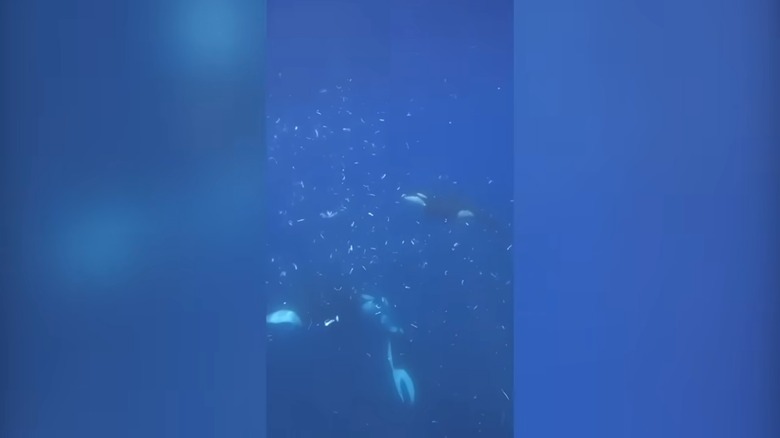
In a brief report published in Frontiers in Ethology, researchers describe an orca behavior that has never been seen before but has now been captured on two different occasions around the Baja California Sur peninsula in Mexico. The first time footage was captured by Beneath The Waves scientist and first author Dr. Kathryn Ayres on July 19, 2024, with an adult female holding a sharp-tail sunfish carcass in its mouth. Teed up, a belly-up adult male darted toward the carcass, striking it at such a high velocity that the camera picked up the sound. Then, the sunfish's tissue spread throughout the area.
The second time this "high-speed ramming maneuver" was filmed was on September 7, 2025, by a third party. In it, you can see an adult orca teeing up a sharp-tail sunfish and a second crashing through it and toward the camera as if from nowhere (but actually from the other side of the first adult). Just like in the first captured footage, the tissue fragments from the sunfish spread and floated around.
Why orcas use this 'ram-to-fragment' behavior
Among the tough animal species that have no natural predators, orcas live in groups called pods that can range in size from just two to 15 killer whales. Groups are known to combine temporarily for seasonal feeding, mating, and simply to be social with one another. Within the pods, these animals have a caring nature for each other, with each individual sharing the responsibility for helping the sick and injured, as well as raising the young. That could be what we're seeing in the aftermath of the orcas' high-impact ramming behavior.
After the sharp-tail sunfish explodes in the first video, you can see the male and female adult feeding on what's left of the split-open carcass. Meanwhile, a juvenile that's much smaller than the female adult joins the feeding but only swims through and consumes the floating pieces of tissue. It's a little more difficult to see in the second video because all three of the orcas are adults. However, the first orca feeds on the tissue fragments, while a third joins the second to feed on the remaining carcass.
Since the young orca is seen feeding on the broken-up sunfish pieces in the first footage captured, the researchers theorize that it's an act of the parents breaking down the prey into smaller pieces for their baby to eat. This behavior could also simply be how killer whales distribute prey resources among pod members or part of their social and play time. As Dr. Ayres noted in a press release, "Orcas are known for playing with their food."
About sharp-tail sunfish and a potentially unexpected discovery
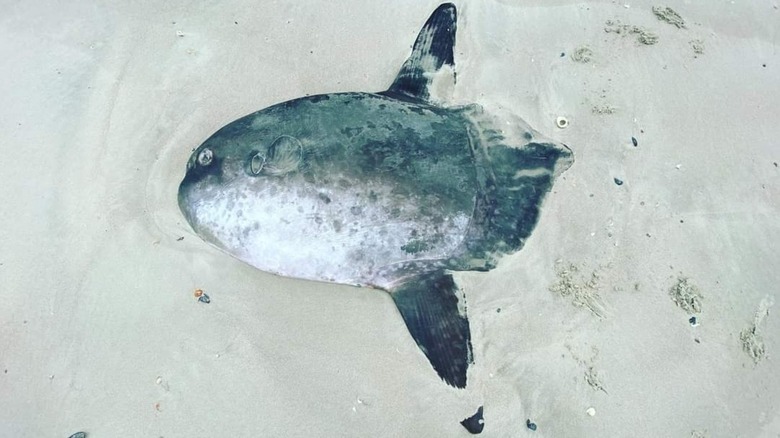
Because of the confluence of cold and warm ocean currents around the Gulf of California where this orca ram-to-fragment behavior was filmed, the waters are rich in nutrients that can sustain megafauna populations. Those include teleost species like sharp-tail sunfish (Masturus lanceolatus), which can grow up to 11 feet and weigh up to 4,000 pounds.
While they haven't been studied as much in this region compared to others, scientists have observed sharp-tail sunfish at various depths — descending more than 2,300 feet under the surface. They don't stay that deep, though, ascending closer to the surface for rest, parasite removal, and thermoregulation. When they surface, though, they become vulnerable prey for orcas — no matter which ocean or sea they inhabit — despite being strong swimmers and quickly making evasive moves during interactions.
What the researchers didn't expect was the level of tissue disintegration that occurred when the orcas rammed into the sharp-tail sunfish carcasses. It's possible that this could be a structural response that only this specific species of sunfish has to such an impact. During those filmed interactions, though, the orcas had already eaten the sunfishes' internal organs. Because of that, Dr. Ayres explained to CNN, "We haven't seen this type of prey fragmentation described in other sunfish species, so it's difficult to know whether it reflects something unique about the anatomy of Masturus lanceolatus, the specific behaviour of these orcas, or a combination of both."