

This 'Useless' Body Part Has A Major Benefit
There are at least 78 organs in the human body, although two additional organs are still debated since their discovery in 2016 and 2018. Those aren't the only controversial body parts, with scientists still debating the potential uselessness of some organs. For instance, the thymus gland is one "useless" organ that's more important to your health than thought, while the spleen is a "useless" organ that can actually protect your body against infection. Another body part that seems useless but is actually beneficial is the adenoid.
Although commonly referred to as the plural "adenoids," the adenoid is a single mass of lymphoid tissue that rests behind the palate at the intersection of the nasal passages and throat. Also called the pharyngeal tonsil, it forms during embryological development and grows to its largest size between the ages of 2 and 6 before starting to shrink. By adolescence, the adenoid atrophies, and by adulthood, it disappears.
That explains why the adenoid is seemingly a useless organ, but it's actually a useful part of the lymphatic system. Like tonsils, it helps trap bacteria and viruses that may pass through the nose, mouth, and throat to protect young children from infections. It also produces antibodies and helps balance bodily fluids. On top of that, the adenoid aids the establishment of immunologic memory and, like the thymus gland, produces T cells (a type of white blood cell) that fight infection and possibly cancer.
Why the adenoid may be removed and is possible to live without
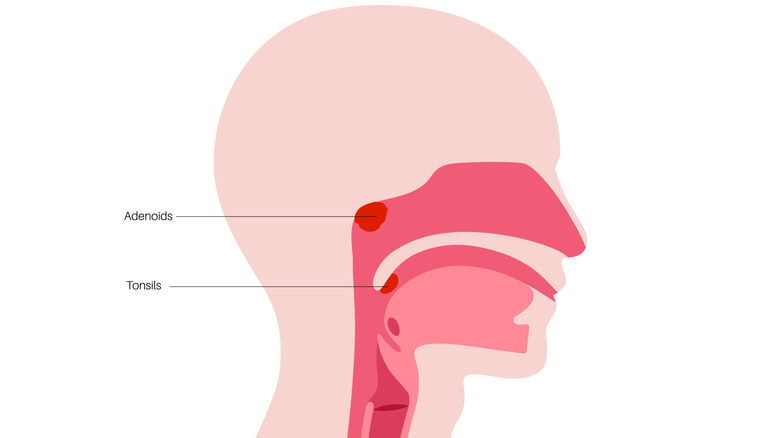
While some children and adolescents have enlarged adenoids that aren't a problem, it can sometimes be a sign of infection from bacteria or viruses, allergies, gastroesophageal reflux, or other irritants. An enlarged adenoid is rarely the result of cancer. In any case, a larger-than-usual adenoid can block the eustachian tubes (the body part that explains why humans get ear infections) or nose. That blockage can make it difficult to breathe and even cause bad breath, hearing issues, nose bleeds, and obstructive sleep apnea.
Whether adenoid hypertrophy (impaired clearance) or frequent adenoiditis (inflammation) are the cause behind an enlarged adenoid, an adenoidectomy (surgical removal) could be necessary. This procedure is performed with general anesthesia, and although removing all of it may not be possible, the surgeon will be able to get most of it.
Since the adenoid is a small part of the lymphatic system (and therefore immune system) and shrinks to nothing by adulthood, children who have theirs removed don't generally get sick more often than those who still have it. That's because other parts of the immune system and lymphatic tissue are able to compensate. In fact, some kids who don't have adenoids get fewer nasal infections and other illnesses.