

How The US Military Trained Pigeons To Guide Missiles In World War II
We may receive a commission on purchases made from links.
After World War II, the United States conducted a lot of secret tests. The military conducted risky germ warfare experiments on unsuspecting Americans, and scientists tested nuclear weapons. These and other hidden projects weren't the first, though. While many of them became controversial after they were revealed to the public, some of them are more impressive than anything else. One example that seems sort of bizarre is a study conducted during World War II that involved training kamikaze pilot pigeons to guide missiles.
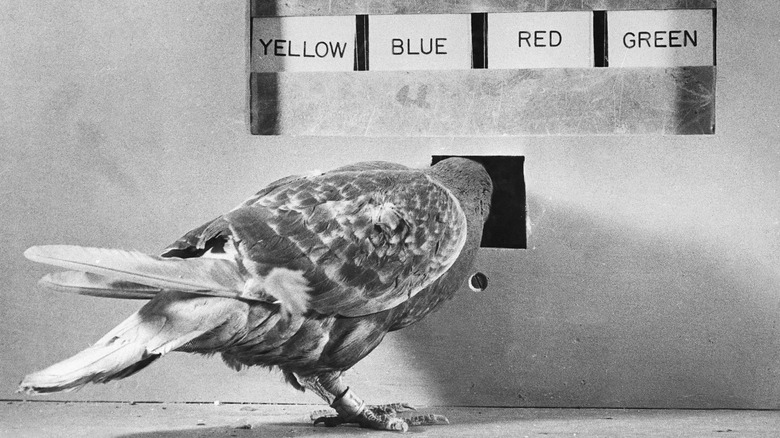
Code-named Project Pigeon, the "Pigeons in a Pelican" study was the brainchild of inventor and behavioral psychologist Burrhus Frederic Skinner. He purchased some pigeons and designed harness-like jackets out of men's socks to contain the bodies and wings but allow the necks and heads to move unencumbered. Using grain kernels as a reward incentive, the birds were trained to peck a specific image — such as a building or a ship — while being held in front of a screen. After encouraging the pigeons to peck as fast as they could, they were eventually able to perform about 10,000 pecks per 45 minutes (222 pecks per minute). However, there's more to the story than just how Skinner trained the birds.
Why Skinner decided to train pigeons to guide missiles to ground targets
Air bombs at the time of World War II didn't have the accuracy they have today because the technology simply wasn't there yet. After the bombing of Warsaw by the Germans in 1939, Skinner got the idea to use birds as missile guides while watching them fly alongside the train he was riding. In his autobiography "The Shaping of a Behaviorist," he recalled, "Suddenly I saw them as 'devices' with excellent vision and extraordinary maneuverability. Could they not guide a missile? Was the answer to the problem waiting for me in my own backyard?"
Skinner had done extensive research on conditioning the behavior of animals and wondered if birds could learn to guide missiles or shells to a ground target after being released from a plane. Along with having excellent eyesight and the ability to distinguish colors, he specifically chose pigeons because they were easier to handle and have higher predictability compared to other species. After all, pigeon nests look horrible, but these birds are far from stupid. People have been using messenger and homing pigeons for thousands of years, too. However, this "bird-brained" idea went through several stages of refinement before the U.S. military took interest.
How the pigeon-missile technology worked and why it was never used
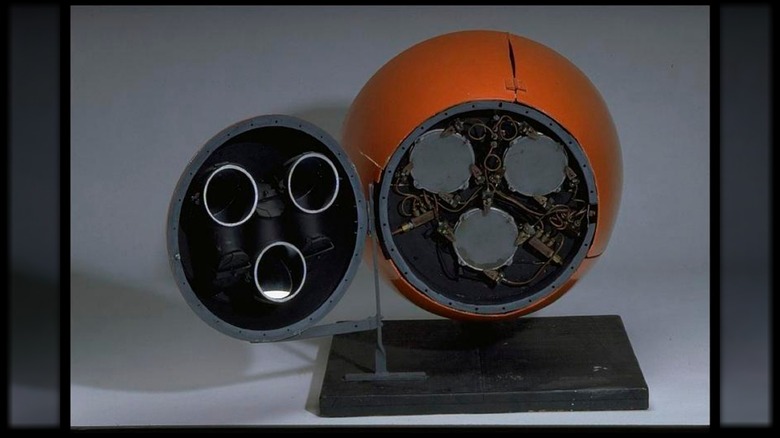
The technology used for Project Pigeon was just as brilliant as the project itself was bizarre. One of the earliest systems attached lightweight rods to the pigeons' necks and electrical contacts to the rods so that it could steer by moving its head up, down, and side to side. When the birds were placed in the apparatus with food as incentive, they were able to move their heads in order to reach a bull's eye on the wall across the room. In 1943, Project Pigeon was promising enough for the Office of Scientific Research and Development to award funding, allowing Skinner to continue testing with some new ideas. That only lasted for a little over a year as more promising missile technologies emerged.
Despite being left on the back burner, B.F. Skinner kept testing his birds to see if they remembered what they learned, and those tests were successful. His project was revived in 1948 as Project Orcon when the U.S. Navy took interest. That's when Skinner was able to refine the system using a sophisticated simulator with a lens in the glide bomb nose that projected an image of the ground onto a conductive screen. With the pigeon's beaks fitted with gold electrodes, the screen could track where the birds pecked and activate servo motors for steering the bomb wings. The pigeons repeatedly performed well using actual combat projections and hemp seeds as incentive.
However, the project was terminated in 1953 with the improved reliability of electronic guidance systems. At least there was a silver lining — the conductive screen that was developed for Skinner's project was implemented in U.S. warship combat control centers and used to track attacking aircraft.