

The US Military Secretly Tested Drugs And Nerve Agents On Thousands Of Soldiers At A Maryland Base In The '60s
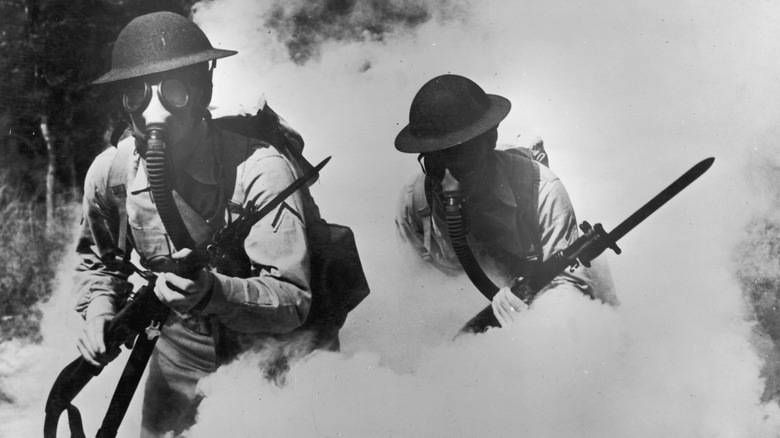
As World War II ended, the relationship between the Allies began to break down and developed into the Cold War — an era of economic, propagandistic, and political rivalry. The tension peaked from the late 1940s to early 1950s, a period referred to as the Red Scare. During that time, the government and military secretly started conducting experiments in an effort to understand how potential chemical warfare could be used and defended against. Drugs and nerve agents were even tested on soldiers at Edgewood Arsenal in Maryland.
Among the many biological tests carried out, the U.S. military ran risky germ warfare experiments on unsuspecting Americans in 1950. Another shady government experiment that changed the U.S. forever involved the spread of zinc cadmium sulfide over cities throughout the '50s and into the '60s. At Edgewood Arsenal — a base established in 1918 as a chemical warfare research and development center — classified medical studies were performed by the Army Chemical Corps Medical Department between 1955 and 1975.
Nearly 7,000 volunteers were subjected to 254 chemicals, including blistering agents, irritants, nerve agents, antidotes, and even psychedelics. Some of those psychoactive agents included cannabinoids, LSD, and PCP. Along with assessing the exposure and treatment effects, the program evaluated the soldiers' mental and physical performance during exposure, as well as the effectiveness of protective clothing and equipment.
The effects of the drug and nerve agent testing on the Edgewood Arsenal soldiers
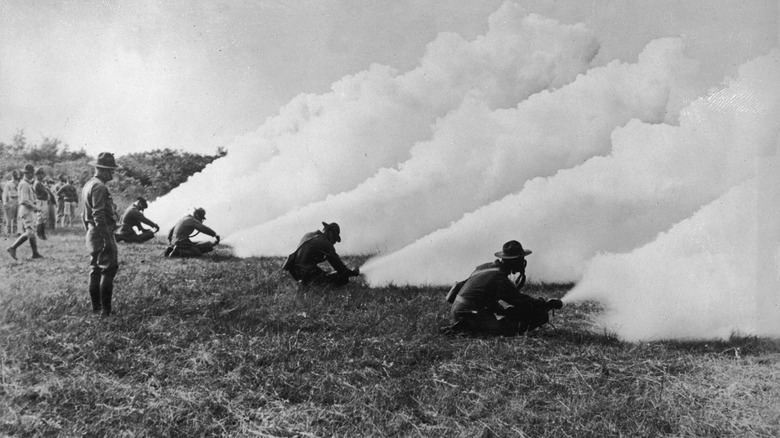
From 1982 to 1985, the Institute of Medicine published a series of studies performed to determine if the volunteer soldiers at Edgewood Arsenal had experienced any adverse health effects from the chemical and drug testing. There were no significant differences found. In Military Medicine in 2003, another study published similar findings. Compared to control volunteers, those exposed to nerve agents reported fewer problems with attention but more sleep disturbances. The effects of the chemical warfare testing at Edgewood Arsenal may not have been as widely experienced as those experienced by the unwitting participants of Project MK-ULTRA — a shady 1950s experiment that tried to harness the power of mind control — but that doesn't mean they weren't felt.
In a 2012 interview with CNN, though, one former soldier, Tim Josephs, who volunteered for the assignment said that there was "no mention of drugs or chemicals." He explained that he didn't know what the injections and pills were because many of them were called "agent one or agent two." Shortly before his two-month stint was up, he was hospitalized for tremors resembling Parkinson's disease, which he was eventually diagnosed with in his mid-50s. The American Homefront Project reported a similar story in 2018, but there are likely many former soldiers who have suffered long-term effects as well.
A Department of Defense report conducted in 2016 found no significant health effects either. In 2018, though, the National Academies of Science reviewed the report and determined that it was incomplete and that it "should not be used as the sole scientific basis to assess the potential long-term health effects" from the chemicals used at Edgewood Arsenal. It also recommended a better evaluation framework.