

Archaeologists Tested 2,000-Year-Old Ancient Roman Baths. What They Found Was Disgusting
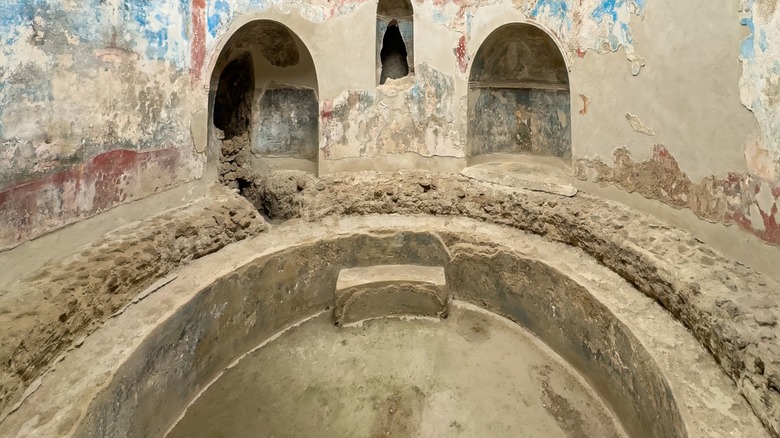
Drawing a fresh bath or taking a shower is one of the most relaxing ways to wash off a long day. For centuries, many civilizations and cultures used public baths as places to socialize. One example are the Republican Baths, the oldest known public bathing facility in Pompeii, which was built around 130 B.C. Unfortunately, those ancient residents were unaware that the bath water they were stewing in was highly contaminated, and the supply was rarely freshened.
Researchers at Johannes Gutenberg University Mainz have used isotope analysis to examine carbonate (limescale) deposits excavated from the Republican, Stabian, and Forum Baths of Pompeii (one of the ancient places rediscovered by scientists). Publishing their findings in PNAS, they discovered that the water contained elevated levels of copper, lead, and zinc. The scientists were able to determine that these heavy metals came from bronze and lead-constructed boilers, lead pipes, hydraulic plaster, and volcanic sources. On top of that, they found traces of human waste, such as urine, sweat, and sebum (an oily substance the body produces to protect the skin).
The most appalling part, though, is that the Pompeii residents weren't renewing the bathing pools regularly. From the time the Republican Baths were constructed until the 1st century A.D., the facility was supplied with water from deep wells using treadwheel-like lifting devices that were powered by slaves. The researchers believe that, based on that and the isotope analysis, the bathing water was only changed once a day. Perhaps that played a part in why ancient Roman poop gave archaeologists physical evidence that parasite infections increased as the Empire conquered lands.
How the Roman Empire improved the hygienic conditions of the public baths
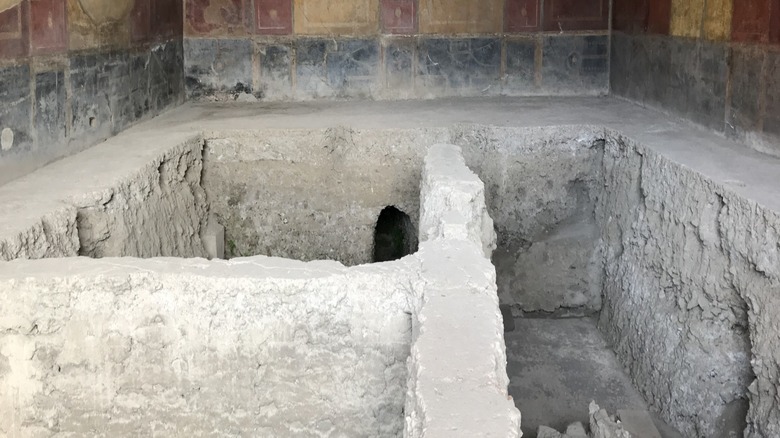
The Samnites were the inhabitants of Pompeii between the 2nd century B.C. and 80 B.C., which is when it became a Roman colony. Over the years, upgrades were made to the deep well and water-lifting system at the Republican Baths, but it was abandoned around 30 B.C. The Stabian Baths were built between 130 and 125 B.C., and the Forum Baths weren't built until the Romans arrived in 80 B.C. Originally supplied with water via deep wells and water-lifting systems, these were also upgraded as ancient technologies improved.
However, the biggest upgrade came when the Romans built an aqueduct in the 1st century A.D., during the reign of the first Roman Emperor Augustus. The Stabian and Forum Baths were still contaminated with heavy metals, especially lead from the lead pipes that funneled the water into the buildings. Initially, there were higher levels of lead in the bath water compared to the original supply system. Those levels decreased over time, likely because carbonate (limescale) gradually built up inside of them.
Despite that, the biggest benefit in relation to hygiene is that the aqueduct significantly increased the availability of water. That means the water could be renewed more regularly, more in line with the high standards for which the Romans are known. As a result, the residents weren't exposed to as much human waste in the bathing pools. It doesn't seem like everyone had the same standards, though, as fecal residue in ancient glass jars revealed physical evidence that the Romans were using poop as medicine.