

Scientists Say This 200 Million-Year-Old Fossil Helps Answer A Centuries-Old Mystery
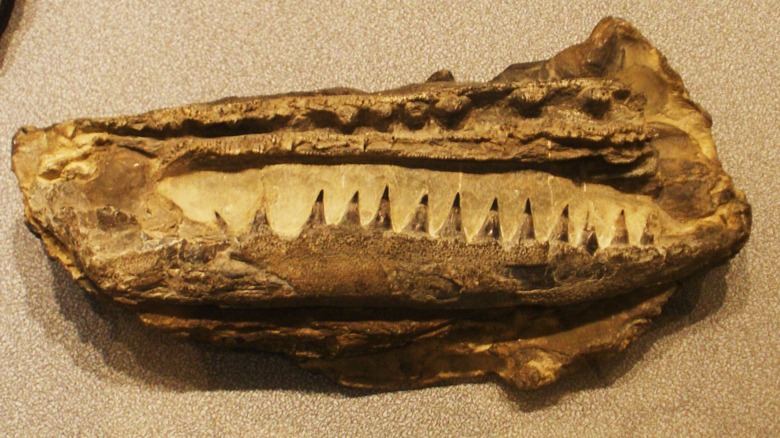
It's amazing what scientists can learn about extinct species by analyzing bones and fossils. For instance, a 3.8-million-year-old skull solved a human evolution mystery and debunked the theory of linear evolution. Unfortunately, some fossils can be miscategorized or be a source of confusion. That's exactly what happened with fossils discovered along the Bristol Channel in the United Kingdom. After being puzzled over for almost two centuries, researchers have finally determined that two ancient fish that had been grouped into the genus Severnichthys, actually belonged to separate genera: Saurichthys and Birgeria.
In 2012, Welsh fossil hunter Jonathan Bow saw an unusual fossil on Lavernock Beach. It's just one of the areas around Bristol Channel where people have been finding rare fossils hidden in plain sight that scientists have had a hard time identifying because of their unique shape. Bow didn't know what it was for many years, but in 2022, he was visited by University of Bristol researcher Jacob Quinn, who decided to analyze it. It took a collaboration of scientists from the university, Amgueddfa Cymru – Museum Wales, and the State Museum of Natural History Stuttgart to confirm that it came from Saurichthys, a predator fish from the Late Triassic period.
After comparing the fossilized jaw to others from across Europe, the researchers determined that it contained developing teeth and was the first from Saurichthys to be found in the rocks of Lavernock Beach. That's when it became clear that the fossils that had been grouped together as Severnichthys are actually fossils from the well-established genera Saurichthys, a long, streamlined fish, and Birgeria, which is a more robust predator.
What researchers know about Saurichthys and Birgeria
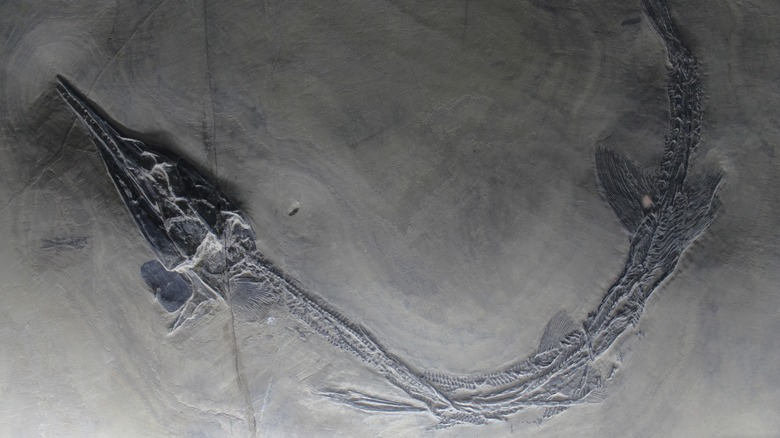
Existing more than 200 million years ago, Saurichthys and Birgeria were both predatory fish that lived in the Triassic oceans. The researchers who analyzed the fossilized jaw with developing teeth noted in a paper that was published in the Journal of Vertebrate Paleontology that Saurichthys is an established but complex genus consisting of more than 50 species that spanned all continents except Antarctica and South America.
According to a paper published in Historical Biology, though, Saurichthys' global distribution seems to have shrunk to the Euramerican region after the Middle Triassic. The genus was among the largest sea predators of the time, generally growing up to 6.5 feet long, although it may not be among prehistoric sea animals that are pure nightmare fuel. This genus of ray-finned fish is characterized by long, slim bodies and pointed snouts, which likely made them fast and agile hunters.
On the other hand, Birgeria was a bigger, more powerful genus of sea predator. They could grow up to 6.1 feet long and had blunt snouts with two to three rows of teeth. Considered an apex predator of the ocean for the period, scientists believe that Birgeria would pursue and bite prey before swallowing it whole, much like modern-day great white sharks. In fact, they may have been the earliest apex predators to live just 1 million years after the Permian–Triassic Mass Extinction 250 million years ago, defying the period's hot equatorial waters.