

Scientists Can Explain Why Your Taste Never Came Back After COVID
Among the roughly 270 known viruses that can infect humans, some of them are gone in less than a week, like the common cold. Others linger and cause long-lasting side effects, like HIV. Although COVID isn't the most contagious disease in the world (it's actually measles), it's a virus that can affect how your body functions over the long term. One of the often-reported effects is a loss of taste, with some people going on six years of being unable to taste food. After examining patients with persistent COVID-related symptoms, scientists believe that a molecular anomaly in the receptor cells of taste buds is the cause.
In the study, which was published in Chemical Senses, researchers examined 28 non-hospitalized patients who were still having trouble with their sense of taste more than one year after coming down with COVID. As part of the study, they performed a taste test to quantify the participants' ability to taste bitter, salty, sour, sweet, and umami. They also biopsied taste bud tissue near the tip of the tongue from 20 of them and analyzed it for structure and messenger RNA (mRNA) expression. Involved in the synthesis of protein, the role of mRNA is to transport protein information for cells to read and translate so that they can make the protein.
What the researchers found was less mRNA present to facilitate the production of the PLCβ2 protein, which is essential for amplifying the signals of bitter, sweet, and umami flavors that taste receptors communicate to the brain. With insufficient PLCβ2 production, the signals are too weak for the brain to register that the body is tasting those qualities.
Other notable observations the scientists made about taste loss post-COVID
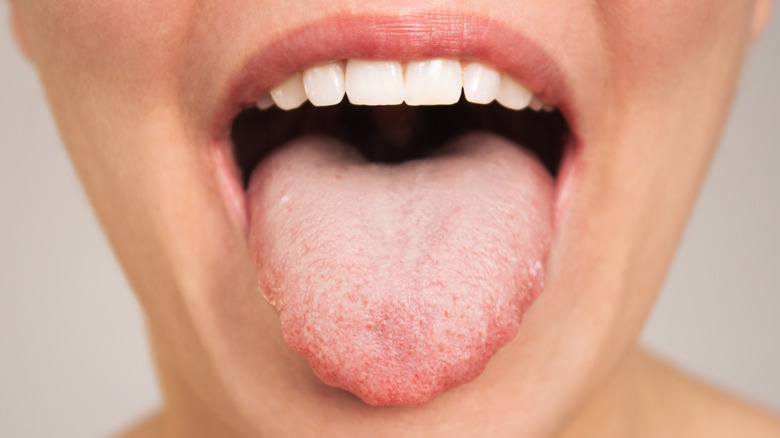
Along with the insufficient mRNA and PLCβ2 production, the researchers discovered a structural disorganization and isolated PLCβ2 protein cells outside of the taste buds in some of the tissue samples. Those abnormalities may contribute to why some people lose the taste aspect of their chemical senses post-COVID, but no concrete correlation was identified between them and the participants' taste scores.
Because of that, it seems the lack of mRNA and PLCβ2 are largely responsible for the loss of bitter, sweet, and umami taste profiles. Of the 28 participants, 11 specifically reported that they couldn't taste those. Interestingly, the scientists noted that salty and sour profiles were mostly preserved. The reason could be that the taste receptor cells don't rely on the same protein pathways to detect and relay signals for those taste qualities.
Scientists don't fully understand the role of the epithelial sodium channel, but they have established that it's involved in differentiating salty taste. This protein passageway allows sodium to enter certain taste cells, which release adenosine triphosphate (ATP), a molecule that supplies energy to cells and also acts as a chemical messenger. When ATP joins with two other proteins to form a channel in the cell membrane, ATP can escape and carry taste signals to nearby nerves.
Sour taste works differently, too. Acids in foods, such as lemon juice and vinegar, release protons (positively charged hydrogen ions). These enter taste receptor cells through the otopetrin-1 channel, a protein in the cell membrane that acts as a passageway specifically for protons. The protons change the cells' electrical activity when they enter, triggering the release of serotonin, a chemical messenger that carries taste signals to nearby nerves.
Hope to reverse the taste bud anomalies after COVID and enjoy food again
Although this research sheds light on why some who have recovered from COVID never regain their taste, further investigation is required to determine if the changes can be reversed. It's understandable that not everyone is willing to wait for that possibility. One option may be olfactory training.
The signals that relay taste and smell to the brain are intertwined. While your taste buds and receptor cells detect the various tastes (salty, sweet, umami), the nose discerns flavors (pistachio, strawberry, steak). That's why many people who have lost their sense of taste because of COVID have also lost their sense of smell. When these senses change or disappear, those affected may feel isolated around others who don't have that problem.
Olfactory training is a treatment used for anosmia (loss of smell), and involves smelling a rotation of essential oils — such as clove, eucalyptus, lemon, oregano, rose, and rosemary — twice a day for a few months while practicing mindfulness. For instance, if you're unable to actually smell the scent, try to remember what it's supposed to smell like. Eventually, this process could stimulate nasal nerve cells to regenerate, resulting in your sense of smell returning. It's not guaranteed, though.
You can practice mindfulness while you eat as well, remembering what a dish is supposed to taste like with each bite. Try to focus on the texture and how it feels on your palate as well. If you're like some of the participants involved in the Chemical Senses study, you might still taste salty and sour, and that sensory adaptation could stave off any isolation you feel and help you enjoy food again (at least a little).