

Archaeologists Tested The Longest Human Poop In The World. What They Found Was Stomach-Churning
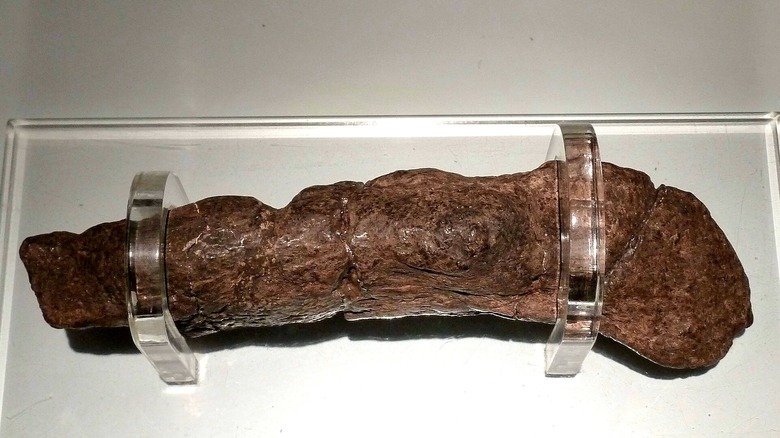
Fossilized feces are called coprolites, while human-produced coprolites are called paleofeces. And the fossil record contains some truly remarkable specimens. The record-breaking "Lloyds Bank Coprolite" is widely considered to be the largest, longest, intact piece of paleofeces ever found. The specimen was first laid by an unknown pooper in 9th-century York, England during a period of Viking settlement, and it was discovered in 1972. In the 50 years since its discovery, this giant "Viking" poop has provided anthropologists with insights into the diet, lifestyle, and even parasitic diseases of its defecator.
Measuring around 8 inches long and 2 inches in girth, the fossilized poop is about the size of a standard 16.9-ounce plastic water bottle. Although fossilization has transformed the specimen into a rock, we can estimate that the original poop had an approximate volume of 17–25 cubic inches and probably weighed about 9.8–14.5 ounces. In other words, it weighed about a pound at the "moment of production" before becoming fossilized.
Obviously, the fossilized turd in question isn't the definitive longest-poop ever laid (some readers may believe they've produced the true record-holder). It is, however, the longest human paleofeces ever recorded. Its most famous analysis came from Dr. Andrew K. G. Jones in the '70s and '80s. By rehydrating and filtering a small chunk, Dr. Jones discovered hundreds of microscopic parasitic eggs in the solution from the species Trichuris trichiura (whipworm) and Ascaris lumbricoides (maw-worm). Paleoscatologists have long found parasites in coprolites, including in ancient Rome. In the case of the Lloyds Bank Coprolite, the hundreds of parasitic eggs painted a not-so-glamorous picture of life as a Nordic settler.
The fate of the biggest fossilized human poop ever found
Today, the 8-inch-long Lloyds Bank Coprolite sits in a glass display case at the JORVIK Viking Centre in York, England, where it will likely remain. After decades of poking and prodding, the paleofeces are now considered too delicate to conduct further destructive tests without destroying its structure. This protection heightened in 2003 when a tour group member dropped the poop and it broke apart. After carefully gluing the specimen back together, its caretakers have virtually retired the specimen from physical inspections.
Nonetheless, Dr. Jones' thorough study of the sample has provided contemporary archaeologists with a baseline of data for comparing it with other fossilized poops. For example, in a 2022 study, a team of European researchers were able to use ancient Nordic poop to model the genetic evolution of whipworm parasites over the past millennium. Their findings will hopefully aid in the fight against the parasite's spread, which has ravaged impoverished populations for centuries. (Scientists have even analyzed 2,000-year-old Roman gut genomes and found a similar story of infections.)
Even wider studies have used "Viking poop" as a data point. In a 2012 literature review, researchers included Viking-era coprolites in an expansive study that demonstrates just how much knowledge can be gleaned from fossilized poop. And in a 2014 study, U.K. researchers analyzed the water-logged areas in York, including the Lloyds Bank Coprolite's site, and they found that there was a high amount of intestinal parasites. In fact, whipworm and giant roundworm were in almost every fossilized poop they found. Apparently, ancient "Vikings" lived in shockingly poor living conditions, and poop was likely everywhere.
How Viking poop helps disprove the Viking myth

Archaeological research points to one glaring conclusion: Ancient Vikings weren't as robust and healthy as Hollywood would have us believe. The romanticized image of the Viking conqueror, with his broad chest, full beard, and impeccable bowel movements, is built around legends. The image likely worked in the so-called "Vikings'" favor by spreading fear and propaganda in advance of each group's attempts at conquest. The legendary Viking figure also conflicted with the real Nordic identity groups, since the population of Scandinavia was highly divided along political, ethnic, and geographical borders at the time.
But the Lloyds Bank Coprolite dispels the myth of the invincible Viking warrior. With hundreds of eggs from two powerful species of parasite, the Nordic settler that laid the 8-incher in 9th-century York, England probably had a terrible diet. They likely suffered from stomach pain, constant nausea, and constipation or diarrhea, ailments brought on by their unsanitary living conditions. Even more damning, the maw-worm and whipworm parasites exclusively travel via fecal–oral contamination, meaning Nordic settlers were regularly consuming fecal matter.
How the Lloyds Bank Coprolite became so long and large is unknown. It's possible that its producer was constipated and passed an exceptionally large stool after days of compaction. It's also highly possible that the person who produced the poop consumed a meat-heavy diet with a poor-quality fiber intake (though fiber's role in constipation is often misunderstood). In any case, the result was an impressively large specimen — and archaeologists continue to study its progenitors.