

In The '50s, The US Military Secretly Detonated Nukes In The Atmosphere. They Didn't Expect What Happened Next.
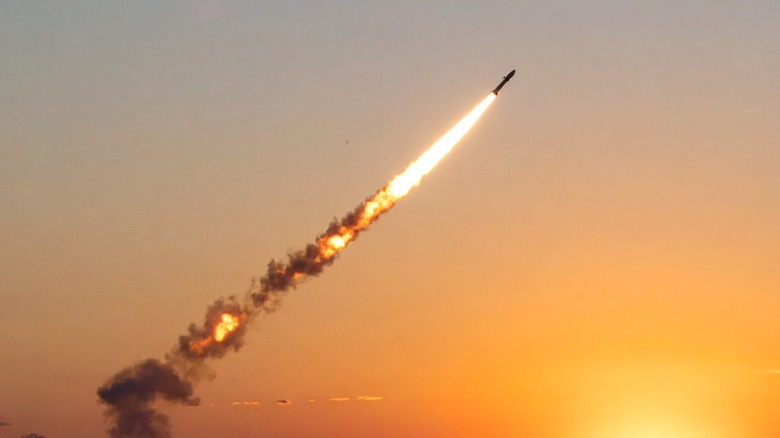
Research and development before and during World War II led to new missile technologies, some of which were then implemented during the Cold War. As part of that R&D, the U.S. military detonated the world's first nuke in the 1940s, and many more nuclear tests followed. Some of those included a series of detonations in Earth's upper atmosphere by the U.S. Navy as part of Operation Argus. However, they didn't expect the radiation belts left by the nukes to dissipate as quickly as they did.
The purpose of Operation Argus wasn't to test weapons design or its effects. Instead, its purpose was to prove a theory set forth by physicist Nicholas Christofilos that nuclear missiles exploding at a high altitude could create artificial radiation belts that would interfere with radios, radars, and weapons. So, from late August to early September 1958, the nine-ship, 4,500-men U.S. Navy Task Force 88 was tasked with secretly detonating modified missiles carrying low-yield nuclear warheads at altitudes of 125 to 300 miles over the South Atlantic.
The warhead explosions released a lot of radioactive material into the atmosphere, and Christofilos was right about the transmission disruptions. Additionally, they immediately created auroras along the Earth's magnetic field lines, which could be seen in the North Atlantic. With the Explorer IV satellite positioned in orbit beforehand and air and ground instruments, researchers were able to study the effects and monitor the particles. However, the artificial radiation belts only lasted three weeks to one month. Scientists didn't observe any interference and concluded that the particles scattered with the air molecules and naturally dissipated.
Operation Argus provided great scientific advancement but almost remained secret
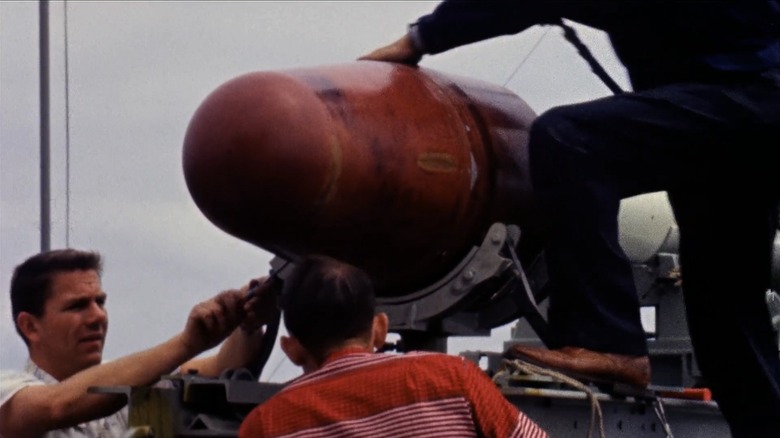
The Operation Argus radiation belts disappeared too fast to be of military use, but researchers were able to gather and analyze a lot of valuable data. In one paper published in the Journal of Geophysical Research, for instance, the authors reported that the geomagnetically trapped electrons produced by the nuclear explosions were easy to distinguish from naturally occurring electrons because they displayed a distinct spectrum of energy. The data was invaluable at helping scientists learn about the Earth's magnetosphere, with the electrons trapped within the artificial radiation belts spiraling vast distances along the Earth's magnetic field lines.
Also, Argus demonstrated that it's possible to test low-yield nuclear warheads at high altitudes without exposing the personnel to detectable radiation. That's because the radioactive material was injected into the stratosphere or higher, where weather couldn't precipitate the debris quickly enough to expose those nearby. It's a different story than Operation Plumbbob in 1957, when soldiers were exposed to the nuclear blasts, particularly the Smoky test. In 1977, the Centers for Disease Control and Prevention detected more cases of leukemia than anticipated among those personnel.
However, what The New York Times called the "greatest scientific experiment ever conducted" (per the Operation Argus 1958 review) wasn't intended to be made public. Seeing the value of being able to study the data, physicist James Van Allen urged the government to declassify the operation and release its findings in a February 1959 memorandum to the Eisenhower administration. Further pressure was applied the following month when military correspondent Hanson Baldwin and science reporter Walter Sullivan published an unauthorized story about the tests. As a result, the government publicly acknowledged the operation, classifying it as part of a civilian science program and releasing the details.