

Archaeologists Solved The Mystery Behind This Impressive 1,600-Year-Old Ancient Roman Invention
While some of the ancient Roman artifacts and structures uncovered by archaeologists have remained mysterious, others have been clearly identified and explained. Archaeologists have found lots of Roman technologies that were ahead of their time. One is the infamous color-changing Lycurgus Cup, and it took decades for scientists to confirm that nanotechnology made the rare glass special.
The 1,600-year-old Lycurgus Cup is a type of vessel known as a diatreta or cage cup, and it's characterized by the outer decoration standing separate from the vessel body, only connecting by bridges or shanks. Although 1960s chemical analyses suggested that fine gold and silver particles were responsible for the cup looking green or red depending on the lighting, researchers couldn't confirm it until 1990. Publishing their findings in Archaeometry, the scientists used a modern analysis technique called transmission electron microscopy to identify the metal particles in a tiny sample.
They found particles about 50 to 100 nanometers, and the atomic percentages (proportions based on atom amounts) of the metals inside included 2.6% copper, 31.2% gold, and 66.2% silver. The researchers determined that the glass itself contained about 40 parts per million of gold and 300 parts per million of silver. There's nothing to suggest, though, that the ancient Romans understood the physics behind why the glass changed from green to red. Therefore, they were unable to control the process, resulting in a short-lived technology.
How the ancient Roman nanotechnology works in the Lycurgus Cup
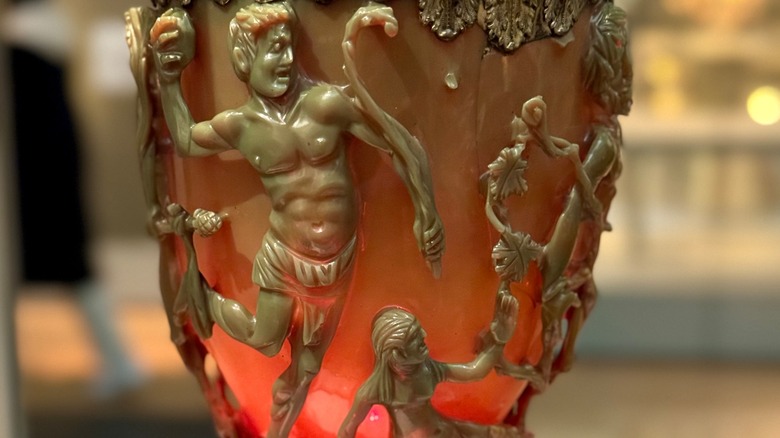
The ancient Romans may not have understood that they had stumbled onto nanotechnology, but modern scientists have figured it out. Essentially, various chemical processes occur to create the dichroic effect, an optical phenomenon where an object changes color depending on whether light passes through it or reflects off it.
First of all, the Lycurgus Cup was made from an about 0.6-inch-thick blown glass blank, and silver and gold were dissolved into the molten glass. Subsequent heat treatment then resulted in the metals turning into metallic atoms that clustered together to form the nanoparticles. Researchers believe this was facilitated by chemical reactions triggered by antimony. During the ancient Roman period, glassmakers often added this silvery-white metal, which naturally occurs in Earth's crust, as an opacifier and oxidizing agent.
The dichroic effect is also a case of getting the nanoparticles the right size — coarse enough to reflect light and create substantial opacity, yet fine enough to allow the transmission of light. If the nanoparticles grow to about 40 nanometers and larger, they're more likely to scatter light than let it pass through.
In the end, the 50- to 100-nanometer nanoparticles in the Lycurgus Cup have a higher atomic percentage of silver than gold. That's why, when direct light hits the glass from the outside, the silver reflects the light back toward the viewer, resulting in the opaque greenish color. When light shines into the cup from the top, it shines through the glass and nanoparticles, where the gold is responsible for making it look red. Perhaps, one day, another mysterious ancient Roman artifact that still baffles archaeologists will be solved: the dodecahedron.
University of Sheffield experts use the ancient nanotechnology to replicate glass with the dichroic effect
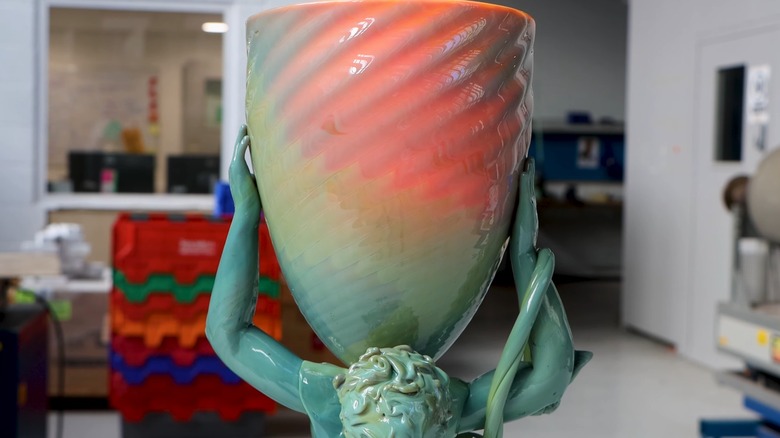
It may have taken decades for scientists to confirm why the 4th-century Lycurgus Cup could turn from green to red under certain lighting conditions. However, it took until 2026 for experts to replicate the dichroic effect (a form of light polarization) at the University of Sheffield in the United Kingdom. Many people have tried over the years with limited success, but doing it consistently hasn't been possible. That changed when the university's School of Chemical, Materials and Biological Engineering technician Dr. Lisa Hollands received a challenge to reproduce the effect for its LightFest event.
Working with professor Carline Jackson, a top Roman glass expert, the pair researched what scientists have learned about dichroic glass like the Lycurgus Cup. They then developed base glass to determine the right starting materials to which they could add silver and gold. Next, they experimented with melting temperatures to create the right shape and size of nanoparticles that mimicked the ancient Roman artifact. They only had slight success at first and realized that too much oxygen was preventing them from getting the right nanoparticles. So, they added an organic material to the glass-making process, and it worked.
With the recipe in hand, Hollands turned to Blowfish Glass artist Elliot Walker to turn it into a beautiful sculpture. He and his team found it a little difficult to blow the vessel part of the replica because of the glass' opacity but easy to sculpt the base. Combining ancient artistry with modern art and glass, the sculpture debuted at the event in November 2026 and will be displayed permanently at the university's Turner Museum of Glass.