

Scientists Dropped Dead Pigs Nearly 1,000 Feet In The Sea. They Didn't Expect What Happened Next
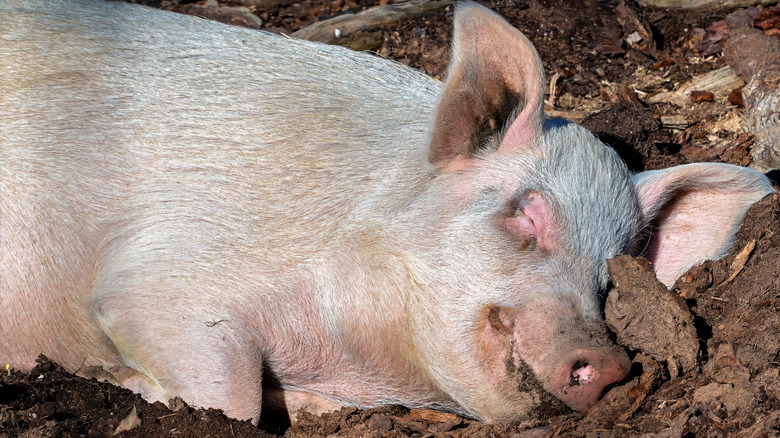
Researchers conduct some bizarre experiments, and while they may go as planned, they might also uncover something unexpected. For instance, scientists dropped gophers onto the volcano Mount St. Helens in the hopes of helping regenerate the area. It worked, but they were surprised by the microbial community hiding underground. Even more strange, researchers put dead alligators 6,600 feet deep in the Gulf of Mexico to observe the ecological impact and unexpectedly discovered a new marine species. Another team of scientists dropped a series of dead pigs into the Strait of Georgia but didn't expect how fast they were devoured.
While it sounds weird to put dead pigs 984 feet into the Pacific Ocean near the coast of British Columbia, Simon Fraser University scientists did so to study the effects of submersion on human decomposition. Pigs were used because their anatomy is strikingly similar to ours. Publishing their findings in PLOS One, the researchers wrote about how they had to change the experiment protocol after the unexpected result with their first deployed pig carcass. A bluntnose sixgill shark (Hexanchus griseus) approached and began to feed on it just eight hours later, and several others arrived shortly after, devouring the pig within 24 hours. To protect some of the future carcasses from the same fate, the team designed a cage over one of the two platforms used to set the carcasses on the seafloor.
Why the sharks devouring the pig carcass was so unexpected
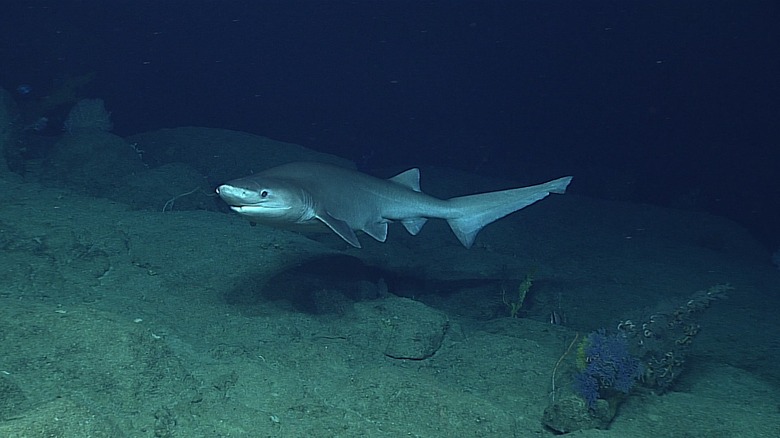
The reason the researchers didn't expect sharks to chow down on a dead animal carcass left fully exposed in its home was lack of oxygen. In fact, dissolved oxygen was one of the environmental factors the team monitored throughout their experiments, tracking the rise and fall down to the hour. That's because oxygen levels significantly decline the deeper you go, with oxygen-deficient zones occurring as shallow as 115 feet deep.
Additionally, an earlier experiment, which deployed three pig carcasses in the nearby Saanich Inlet, didn't attract the shark group feeding like the Strait of Georgia experiment did. Sharks fed on the first and second pig carcasses, but not the third (which had the lowest oxygen levels). Despite that, the swine remains survived much longer than a day.
These experiments led the scientists to conclude that dissolved oxygen levels have a big impact on feeding habits, especially since they observed much lower oxygen levels in the Saanich Inlet than the Strait of Georgia. The lower the levels, the less likely wildlife is to stick around to feed because they'll suffocate without oxygen. As a matter of fact, that's exactly what happened with the deadly chain reaction nearly 9.4 tons of hippo poop triggered in the Mara River of Kenya, killing a lot of fish.
The bluntnose sixgill sharks that fed on the fourth carcass may be a group of daredevils, or maybe they can tolerate lower oxygen levels than believed. In any case, the researchers were surprised at how much animals would push their limits for food.