

In The '70s, The US Military Detonated A Nuke Underground. They Didn't Expect What Happened Next.
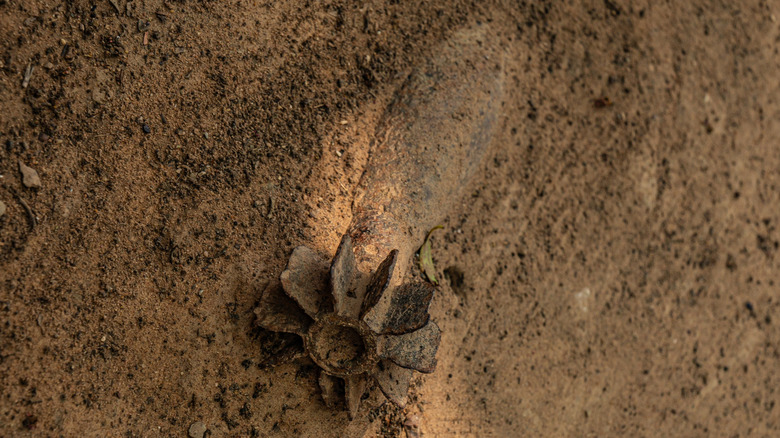
With political tensions running high throughout the mid-20th century because of World War II and the Cold War, the U.S. government began pouring money into military research and development. That money funded a wide range of projects — from training pigeons to guide missiles during World War II to more than 1,000 nuclear weapons tests. Among the latter, several operations failed because of miscalculations and unforeseen circumstances. When the military detonated a nuclear weapon underground, for instance, they didn't expect the above-ground explosion that followed.
On December 18, 1970, the U.S. military put a 10-kiloton (low-yield) nuclear missile in a nearly 7.2-inch-wide, 910-foot-deep hole at the Nevada Test Site (NTS) for the Baneberry test. Everything was going as planned until about 3.5 minutes after the underground bomb was detonated. That's when a crevice opened in the ground about 300 feet away, and a mess of radioactive debris spewed about 10,000 feet high for an extended period, even after the surface collapsed about 16.5 minutes after the explosion. Although the venting dissipated over time, the area continued to emanate vapor for 24 hours.
Since the result of the Baneberry test was so unexpected, NTS operations were suspended for an investigation that lasted about six months. The U.S. Atomic Energy Commission (AEC) determined that, unlike other testing areas, the geologic environment of the site was unique and had an unusually high water content, increasing the underground pressure and magnifying the energy of the explosion.
The Baneberry test fallout exposed personnel and multiple states to radiation
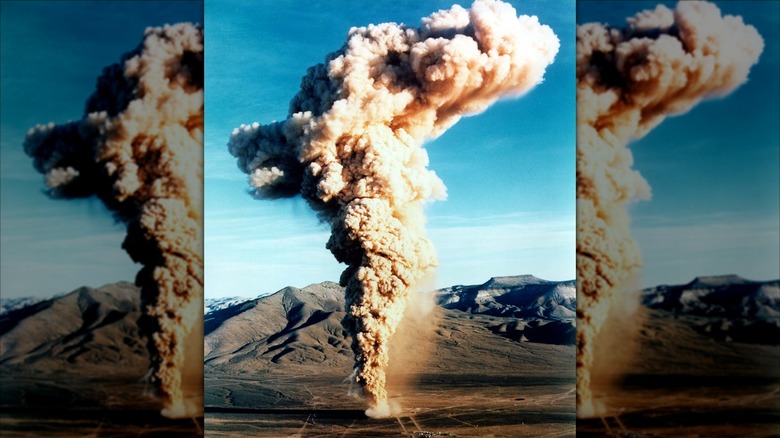
Like when scientists tested nuclear weapons in the '50s (Castle Bravo) and tried to bury nukes underground in the '60s (Operation Iceworm), there was some disturbing fallout from the failed Baneberry test. It was part of Operation Emery, which conducted more than a dozen nuclear tests from October 1970 to June 1971. While a few of those other detonations involved radioactivity being accidentally released above ground, those mishaps remained within the detonation areas. The Baneberry test was a totally different story.
The Environmental Protection Agency found that the radioactive debris spread across Nevada's state lines from California to as far away as Washington and Missouri. According to a paper published in The Extractive Industries and Society, 900 military personnel were exposed to the fallout. The AEC confirmed that two security guards were exposed to the highest amounts of radiation among the personnel. It noted that the maximum exposure to off-site personnel and the general public where the radiation spread was well within the guidelines.
However, one of the security guards, Harley Roberts, started getting sick about 18 months after the Baneberry test. The second guard, William Nunamaker, became ill as well. Sadly, both of them died from leukemia just four years following the fallout exposure. The men's widows took the U.S. government to court in a trial that lasted years. While the government was found negligent in its handling of the incident, it was ultimately not found liable because the families couldn't establish the radiation exposure as the cause.