

Archaeologists Explain Why Ancient People Used Poop To Build Their Houses
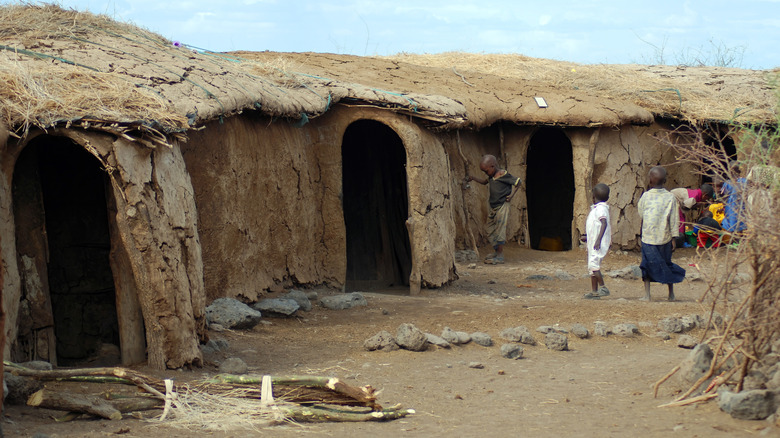
For the most part, people think of poop as a gross topic. That's why it's so surprising to learn that ancient civilizations were using feces — animal and human — in unexpected ways. For instance, archaeologists found physical evidence ancient Romans were using poop in medical treatments, while ancient Egyptians were using poop for birth control. These aren't the only ways dung was being used thousands of years ago. Researchers have found evidence that ancient people were using poop in their building materials, too, and there's a good reason why.
As part of the EU-funded MapDung project, scientists found clear evidence that feces was used to build two sites in the Middle East: Çatalhöyük in Turkey and Tel Tsaf in Israel. These aren't the only archaeological sites where evidence of dung being used in their construction has been found, though. Animal dung was a valuable commodity about 12,000 years ago, when early Neolithic people realized they could use it as a fertilizer, fuel, and building material additive.
Archaeologists aren't sure how the transition played out exactly, however, it's believed that the ancients started to notice the mechanical properties of animal feces after handling it more. They may have gotten the idea to mix it with soil and water for building materials when they saw how it turns hard when it dries out. In fact, poop is an organic additive that helps the ingredients of earth-based building blocks — such as clay, sand, and straw — bind together, shrink, and dry evenly. The result is a building material that's more resistant to cracking than material without the dung.
Ancient people aren't the only ones to use poop to make building materials
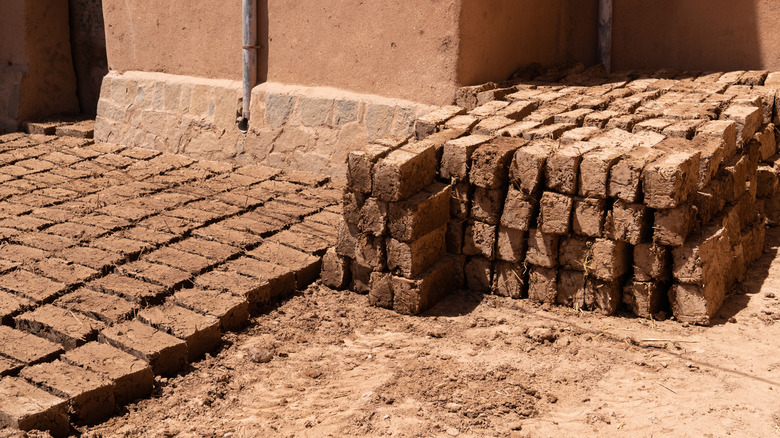
Early Neolithic people may have been the first humans to see the value in animal dung, but they weren't the last. In fact, adobe and cob mixtures are two of the oldest types of earth-based building techniques ever practiced, and they're still used today. Adobe bricks are often made using clay, sand, silt, and water, while cob building ingredients generally include clay, sand, straw, and water — and cow dung can be added to enhance both. In fact, researchers have observed people in Africa, India, and South Asia using herbivorous dung as plaster and in clay mixtures in floor and wall construction during the 21st century.
Meanwhile, scientists have been experimenting with human feces in building materials. A paper published in Buildings in 2019 chronicled the use of biosolids — disinfected and dried sewage leftovers — as an ingredient in clay-fired bricks and saw an increase in compressive strength compared to without the organic matter. In the end, the researchers noted that adding 15% biosolids to the mixture produces "excellent quality clean bricks suitable for use as standard high-quality bricks" while reducing the carbon footprint and energy consumption involved with manufacturing them. Additionally, scientists put human poop into concrete and observed that flexural strength increased 42% after 91 days, which means that it can withstand more stress before it starts to bend, crack, or break.