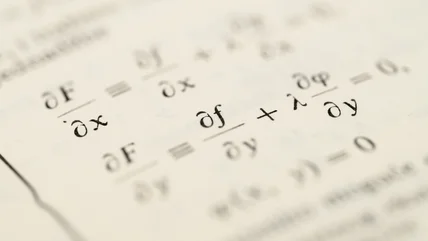
How To Calculate FXY Partial Derivatives
Derivatives are a pretty important thing in calculus, as are partial derivatives. Fortunately, the latter is relatively straightforward to calculate.
Read More

The unique content on Sciencing is a result of skilled collaboration between writers and editors with broad journalistic, academic, and practical expertise across the wide variety of scientific fields we cover.
In pursuit of our mission to provide accurate and ethical coverage, the Sciencing editorial team consistently fact-checks and reviews site content to provide readers with an informative, entertaining, and engaging experience. Click here for more information on our editorial process.
Derivatives are a pretty important thing in calculus, as are partial derivatives. Fortunately, the latter is relatively straightforward to calculate.
Read More
Sphere size is calculated using two measures: the volume (how much space the sphere takes up) and the surface area (the total area of the sphere's surface). Both sphere size and surface area can be easily calculated if you know the radius or diameter of the sphere. The formula for volume is 4/3 times pi times the radius cubed, or 4/3?r^3. The formula for surface is 4 times pi times the radius squared, or 4?r^2.
Read More
Three-dimensional solids such as spheres and cones have two basic equations for calculating size: volume and surface area. Volume refers to the amount of space the solid fills and is measured in three-dimensional units such as cubic inches or cubic centimeters. Surface area refers to the net area of the solid's faces and is measured in two-dimensional units such as square inches or square centimeters.
Read More
There are several theorems in geometry that describe the relationship of angles formed by a line that transverses two parallel lines. If you know the measures of some of the angles formed by the transversal of two parallel lines, you can use these theorems to solve for the measure of other angles in the diagram. Use the Triangle Angle Sum theorem to solve for additional angles in the triangle.
Read More
Atwood machine problems involve two weights connected by a string hung on opposite sides of a pulley. For the sake of simplicity, the string and pulley are assumed to be massless and frictionless, therefore reducing the problem to an exercise in Newton's laws of physics. Solving the Atwood machine problem requires that you calculate the acceleration of the system of weights. This is achieved using Newton's 2nd law: Force equals mass times acceleration. The difficulty of Atwood machine problems lies in determining the tension force on the string.
Read More
The amazing colors in exploding fireworks come from chemical reactions triggered by heat. Combustion propels fireworks into the air while oxidization provides the oxygen needed to excite the metal compounds in fireworks. Energy absorption and emission produce fireworks' unique color spectra.
Read More
There are five main types of algebraic equations, distinguished by the position of variables, the types of operators and functions used, and the behavior of their graphs. Each type of equation has a different expected input and produces an output with a different interpretation. The differences and similarities between the five types of algebraic equations and their uses demonstrate the variety and power of algebraic operations.
Read More
Factoring polynomials with fractional coefficients is more complicated than factoring with whole number coefficients, but you can easily turn every fractional coefficient in your polynomial into a whole number coefficient without changing the overall polynomial. Simply find a common denominator for all the fractions, and then multiply the entire polynomial by that number. This will allow you to cancel out the denominator in each fraction, leaving only whole number coefficients. You can then factor it using normal procedures for factoring.
Read More
Factoring cubic equations is significantly more challenging than factoring quadratics -- there are no guaranteed-to-work methods like guess-and-check and the box method, and the cubic equation, unlike the quadratic equation, is so lengthy and convoluted that it is almost never taught in math classes. Fortunately, there are simple formulas for two types of cubics: the sum of cubes and the difference of cubes. These binomials always factor into the product of a binomial and a trinomial.
Read More
A protractor is required to directly calculate the measure of an angle, but you can use geometric properties of triangles to make an indirect measure of the angle. Use the sine formula to infer the measure of the angle from the distance between two points along the angle's lines a certain distance from the angle's origin.
Read More
The three methods most commonly used to solve systems of equation are substitution, elimination and augmented matrices. Substitution and elimination are simple methods that can effectively solve most systems of two equations in a few straightforward steps. The method of augmented matrices requires more steps, but its application extends to a greater variety of systems.
Read More
Rational expressions contain fractions with polynomials in both the numerator and the denominator. Solving rational expression equations requires more work than solving standard polynomial equations because you have to find the common denominator of the rational terms, then simplify the resulting expressions. Cross-multiplication transforms these equations into regular polynomial equations. Apply techniques such as factoring the the quadratic formula to solve the resulting polynomial equation.
Read More
The golden age of computers began with the digital revolution, but people have been using computers in their daily lives since the beginning of civilization. The history of computers began with simple adding devices. Milestones in the 20th century included the invention of the transistor and the development of the microprocessor, which led to the modern-day computer.
Read More
The FOIL method is the standard procedure for multiplying binomials -- expressions that contain two terms such as "x + 3" or "4a - b." Binomials may have fractions either as constants (free numbers) or as coefficients (numbers that are multiplied by variables). When using the FOIL method with fractions as either coefficients, constants or both, you will need to remember the rules for multiplying and adding fractions.
Read More
A rectangular prism is a three-dimensional solid with several properties relating to its shape, volume and surface area. Rectangular prisms are one of the most fundamental and common shapes in three-dimensional geography, and are also used in fields such as carpentry and graphic design.
Read More
The corrosiveness of an acid or base refers to how severely it damages surfaces upon contact, specifically living tissue. Strong acids and bases such as hydrofluoric acid and sodium hydroxide have a very high or very low pH and are extremely corrosive, requiring extensive precautions when handling because they eat through tissue and even bone.
Read More
Reporting the results of a confirmatory factor analysis necessitates the construction of two tables. The first table contains important information about the goodness-of-fit indicators for each factor model. The second table contains information regarding the factor loading, or relative weight, of each factor. The tables should be formatted according to APA style and presented with a brief description of the significant findings.
Read More
Parallax error occurs when the measurement of an object's length is more or less than the true length because of your eye being positioned at an angle to the measurement markings. For example, a person viewing a car's speedometer from the driver's seat will get an accurate reading because she has a direct line of sight. A person viewing the speedometer from the passenger seat will overestimate the reading because of the angle between his eye, the meter and the arrow.
Read More
The correlation between two variables describes the likelihood that a change in one variable will cause a proportional change in the other variable. A high correlation between two variables suggests they share a common cause or a change in one of the variables is directly responsible for a change in the other variable. Pearson's r value is used to quantify the correlation between two discrete variables.
Read More
The Pythagorean theorem is stated in the classic formula: "a squared plus b squared equals c squared." Many people can recite this formula from memory, but they may not understand how it is used in mathematics. The Pythagorean theorem is a powerful tool for solving values in right angle trigonometry.
Read More
The area of a parallelogram with given vertices in rectangular coordinates can be calculated using the vector cross product. The area of a parallelogram is equal to the product of its base and height. Using vector values derived from the vertices, the product of a parallelogram's base and height is equal to the cross product of two of its adjacent sides. Calculate the area of a parallelogram by finding the vector values of its sides and evaluating the cross product.
Read More
The altitude of a triangle is a straight line projected from a vertex (corner) of the triangle perpendicular (at a right angle) to the opposite side. The altitude is the shortest distance between the vertex and the opposite side, and divides the triangle into two right triangles. The three altitudes (one from each vertex) always intersect at a point called the orthocenter. The orthocenter is inside an acute triangle, outside an obtuse triangle and at the vertex of a right triangle.
Read More
The three types of transformations of a graph are stretches, reflections and shifts. The vertical stretch of a graph measures the stretching or shrinking factor in the vertical direction. For example, if a function increases three times as fast as its parent function, it has a stretch factor of 3. To find the vertical stretch of a graph, create a function based on its transformation from the parent function, plug in an (x, y) pair from the graph and solve for the value A of the stretch.
Read More
Cubic trinomials are more difficult to factor than quadratic polynomials, mainly because there is no simple formula to use as a last resort as there is with the quadratic formula. (There is a cubic formula, but it is absurdly complicated). For most cubic trinomials, you will need a graphing calculator.
Read More
Absolute value equations and inequalities add a twist to algebraic solutions, allowing the solution to be either the positive or negative value of a number. Graphing absolute value equations and inequalities is a more complex procedure than graphing regular equations because you have to simultaneously show the positive and negative solutions. Simplify the process by splitting the equation or inequality into two separate solutions before graphing.
Read More
The solution to linear equations is the value of the two variables that makes both of the equations true. There are many techniques for solving linear equations, such as graphing, substitution, elimination and augmented matrices. Elimination is a method for solving linear equations by cancelling out one of the variables. After cancelling the variable, solve the equation by isolating the remaining variable, then substitute its value into the other equation to solve for the other variable.
Read More
Interval notation is a simplified form of writing the solution to an inequality or system of inequalities, using the bracket and parenthesis symbols in lieu of the inequality symbols. Intervals with parentheses are called open intervals, meaning the variable cannot have the value of the endpoints. For example, the solution 3 < x < 5 is written (3,5) in interval notation, because x cannot be equal to 3 or 5. Express your answers in interval notation by graphing the solution on a number line to determine the upper and lower bounds of the variable.
Read More